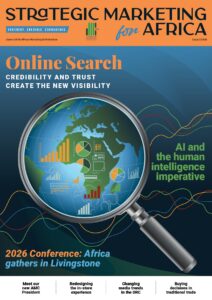
Search is fragmenting – credibility and trust create the new visibility
Online search behaviour has changed significantly with the rise of AI. How can African brands adapt to this new marketing landscape?
BUSINESS STRATEGY
By our African Marketing Confederation News Team | 2026
Shedding of staff forms part of a turnaround strategy for the retailer, as it seeks to strengthen its performance in Southern Africa.
South Africa’s struggling Spar supermarket chain has announced that it will be implementing a voluntary severance programme in certain unspecified areas of the business.
It says it “is part of a broader reset designed to align the group’s cost base with current trading conditions and to ensure that Spar is structured appropriately in order to support future sustainable growth”.
New Spar CEO Reeza Isaacs. Photo: Spar Group
A statement, released to the Johanneedurg Stock Exchange, further noted: “Spar has identified a set of structural initiatives to realign its cost base with prevailing trading conditions and medium-term margin objectives.”
The company also emphasised that the process does not affect the group’s independent retailers or the services it provides to the retail network.
New CEO appointed
The announcement highlights the retailer’s recent difficulties, which have been compounded by high investment costs related to IT infrastructure, including the rollout of its SAP system.
In the wake of its difficulties, Spar recently appointed a new CEO, Reeza Isaacs, to succeed Angelo Swartz, who spent more than two decades with the company in various roles. He resigned in February 2026. Isaacs was previously CFO.
Shortly after taking over on 1 March 2026, Isaacs commented: “I step into the CEO role with absolute clarity on where we are and what must be done to accelerate the turnaround of our core business.
“Spar remains a strong, cash-generative business with a powerful independent retailer network. Our focus now is on increasing the pace of execution – strengthening performance in Southern Africa, improving margin resilience and ensuring that the work already done to simplify the group and strengthen the balance sheet translates into sustainable performance improvement.”
He added: “We are now refining our promotional approach and strengthening commercial discipline to ensure that revenue growth increasingly translates into sustainable profitability.”

Online search behaviour has changed significantly with the rise of AI. How can African brands adapt to this new marketing landscape?

Researchers propose a framework for packaging that senses, learns and acts – making packaging an active, AI-powered tool against food waste.

Country needs marketers to build recognition and consumer trust around Malawian products and national brand, says Deputy Minister.

Fashion brand suspends giant lingerie high above the city’s streets, using shadows to create a moving billboard for pedestrians and motorists.

Researchers describe AI influencers as having a ‘dual identity’. Consumers evaluate both ‘person’ and ‘technology’ identities at once.

Reputation and trust, once modest influences on hotel choice, have become some of the strongest predictors of patronage, study finds.

South African brands are increasingly setting the global benchmark for customer loyalty strategies, organisers say.

Global influences among younger consumers are still present, but they are being filtered through a distinctly Zambian lens.

Researchers find that lack of perceived ‘genuine care’ is the mechanism connecting AI involvement to lower trust ratings.

Explore the 2026 AMC Conference speaker line-up. Top African marketing voices gather in Zambia to tackle AI, AfCFTA, and brand power. Register today.

New industry currency will bring South African television and online video audiences together in a single measurement system.