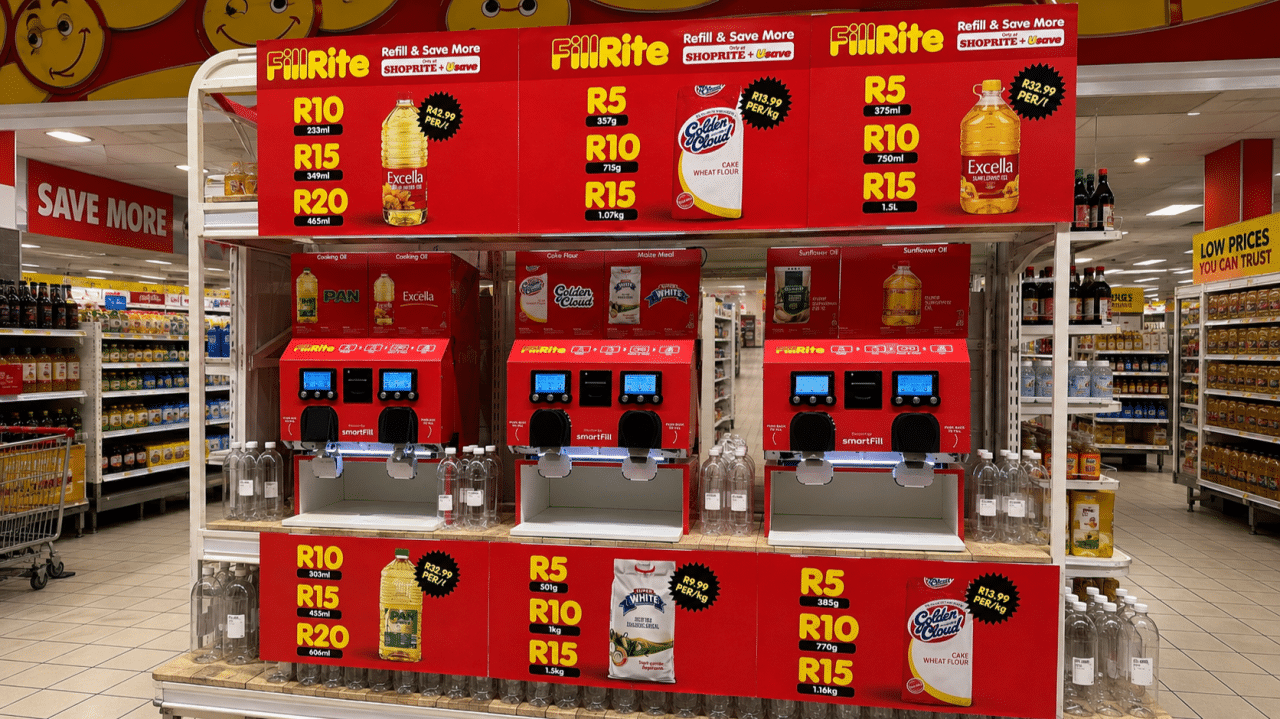
Shoprite, the giant grocery retail group, has introduced a retail concept called FillRite which enables customers to use self-service dispensers to fill up with small quantities of basic necessities such as cooking oil, maize meal, flour and sugar.
However, the FillRite concept, currently operating at three stores, is apparently an action-learning project within the group’s leadership development programme and will not more rolled out more broadly.
Shoprite clarified this to Bona, a popular Southern African lifestyle and consumer magazine, after the publication sought clarification over social media posts alleging that the concept was copied from a smaller local business.
“As inflation and the high cost of living continue to squeeze household budgets across South Africa, micro-dispensing and bulk refill systems are proving to be a game changer for daily budget management,” Bona reported.
“While the concept of automated refill stations isn’t entirely new, having been utilised globally and by zero-waste local stores for years, the massive corporate rollout brings a new level of debate around origin and ethics.”
Fill their own container to a level they can afford
The FillRite concept enables customers to press a button on a dispenser and fill their own container to the level they require or can afford. The system then automatically prints a label showing the amount and price.
Prices start from R5 (about 31 US cents) or R10 (about 63 US cents), depending on the product required.
“The idea is not just to cut packaging costs but also to bring down the cost of staples, because lower income households cannot afford to buy in bulk. Instead, they shop more frequently and for smaller amounts as they earn,” comments Trendtype, the emerging markets consultancy.
Similar self-service concepts are already in operation in some South Africa spaza (informal convenience) stores, as well as with Skubu, a project which is backed by the Department of Science, Technology and Innovation, the Council for Scientific and Industrial Research, and technology firm Sonke.