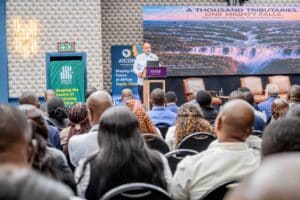
Africa’s economic reset requires moving from ambition to execution
The Africa Commerce Convergence Summit keynote address identified four elements that must converge if the continent is to achieve a meaningful economic reset.
ECONOMY
By our African Marketing Confederation News Team | 2025
New US$1-billion factory will meet domestic demand and establish Egypt as a tyre export centre for Africa, the Middle East and Europe.
The Egyptian government’s efforts to expand and localise the country’s automotive sector are continuing to bear fruit, with the announcement that China’s Sailun Group to build a large tyre-manufacturing facility in the Suez Canal Economic Zone. Total investment is around US$1-billion.
The SCEZ is attracting increased investment. Photo: Presidency of Egypt
This is in addition to the likes of Japan’s Sumitomo Electric Wiring Systems committing to an Egyptian factory – claimed to be the largest of its kind in the world – to manufacture electrical wiring harnesses for vehicles.
Earlier this year, General Motors announced it is assembling the new 2025 Chevrolet Optra in Egypt. BMW began producing cars in the country in 2023.
Meanwhile, this week’s announcement of the new Sailun tyre factory brings yet more development to Egypt’s Suez Canal Economic Zone (SCEZ), which is a collection of six ports and four industrial areas alongside, or near, the strategic waterway.
A tyre export centre
The factory will not only meet domestic demand, but also establish Egypt as a tyre export centre for Africa, the Middle East and Europe, taking advantage of the SCEZ’s location and access to key shipping routes.
Construction will take three years to complete, and the facility will eventually produce 10-million tyres annually, a statement from the Egyptian cabinet said. The first phase is due to be completed in 2026.
“The government has granted the [SCEZ] area special legal and tax advantages to benefit from international shipping passing by. The zone’s chairman said last year that it was spending heavily on infrastructure as it worked to attract investors,” news agency Reuters reports.
According to Business Insider Africa, the latest investment is in line with Egypt’s overall automotive industry goals, which include localising production, reducing reliance on imports and establishing a regional manufacturing hub.
“In recent years, Egypt has implemented policies to attract international automakers and component manufacturers, strengthen local supply chains and boost exports,” the publication states.

The Africa Commerce Convergence Summit keynote address identified four elements that must converge if the continent is to achieve a meaningful economic reset.

Vongani Mageza brings more than 20 years’ experience across financial services and FMCG) companies such as FNB and Diageo.

AI agents will influence shopping, algorithms will supersede social connections, and the clip economy will change how brands connect.

The brand partnership includes a new TV commercial featuring Kipchoge, digital storytelling, wellness initiatives and community programmes.

Modern retail in Africa is still dwarfed by the traditional trade. Marketers who dismiss this relationship-heavy retail model do so at their peril.

Research finds brands don’t just sell products. They can also provide employees with stories through which they feel their work is meaningful

Honesty must be demonstrated through transparency, accountability and action – shaping both reputation and future trust following a crisis.

In the funeral plan category, where most advertisements look like an obituary, Standard Lesotho Bank opted to ‘sell the cow’, not the policy.

Strategic Marketing for Africa, the publication for deep-thinking African marketing professionals, is not to be missed.

CEO of Scopen says the expansion into East Africa is a natural progression following the success of the research in South Africa.

Report says around 80% of Africa’s annual goods export potential to the Caribbean remains untapped.