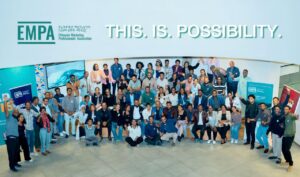
Pre-conference masterclass discusses taking African brands to the world
Participants challenged to identify, articulate and commercialise the cultural assets that make their brand ready for a global audience.
INTERNATIONAL TRADE
By our News Team | 2023
Bottlenecks thwart business growth and challenge marketers due to delays or elevated costs in product delivery, summit delegates hear.
African marketer and young leader, Tarisai Moffat, has just returned from the United States, where she participated in the Mandela Washington Fellowship Program at Jackson State University.
This programme, part of an initiative by the US government, aims to foster international relationships and enhance skills.
Marketer Tarisai Moffat at the Mandela Washington Fellowship Summit, where she discussed the AfCFTA. Photo credit: T. Moffat
Moffat, the owner of Gateway Synergy marketing agency in South Africa, also delivered an Ignite Talk at the Mandela Washington Fellowship Summit 2023 in Washington DC.
This emphasised the importance of Mandela Washington young leaders’ involvement in the African Continental Free Trade Area (AfCTA) to promote a strong African economy with super-responsive trade operations.
She highlighted the significance of AfCTA as a beacon of hope for transforming the continent’s economy by reducing or eliminating restrictive trade laws and transportation issues. These were hindering Africa’s potential for growth and success.
However, Moffat emphasised that waiting until 2063 (AfCFTA’s ‘Agenda 2063’ is a strategic framework for the socio-economic transformation of the continent over the next 50 years.) is not an option, and tangible change must be implemented now for the betterment of future generations.
A fragmented trade landscape
“Trading from Ethiopia to Nigeria, for instance, involves traversing multiple borders laden with customs duties, taxes, licenses and certificates. The ensuing fragmented trade landscape inflates goods’ costs, rendering them unaffordable for consumers and businesses alike,” Moffat explained.
She noted that a seemingly reasonable US$150,000 invoice could incur an additional US$100,000 in transportation costs, significantly exceeding market norms. These bottlenecks thwart business growth and challenge marketers who painstakingly study consumer preferences, only to encounter delays or elevated costs in product delivery.
In her Washington DC presentation, Moffat vividly depicted these challenges, citing a Kenyan battery consignment under the AfCTA that took six weeks to reach its destination due to a complex shipping route.
As the marketing landscape evolves rapidly, with online deliveries setting new expectations of swift turnaround, these trade hindrances were growing more pronounced and hampering market growth.
“This underscores the interdependence of streamlined trade, vibrant economies, and successful marketing strategies,” Moffat said.
Marketers, representing both consumers and traders, share the responsibility of advocating and marketing the merits of free trade, she believes.
Moffat’s Ignite Talk can be viewed on YouTube here.

Participants challenged to identify, articulate and commercialise the cultural assets that make their brand ready for a global audience.

Second outlet planned for Nairobi before year end, with Nigeria, South Africa and Morocco said to be future target markets.

Online search behaviour has changed significantly with the rise of AI. How can African brands adapt to this new marketing landscape?

Researchers propose a framework for packaging that senses, learns and acts – making packaging an active, AI-powered tool against food waste.

Country needs marketers to build recognition and consumer trust around Malawian products and national brand, says Deputy Minister.

Fashion brand suspends giant lingerie high above the city’s streets, using shadows to create a moving billboard for pedestrians and motorists.

Researchers describe AI influencers as having a ‘dual identity’. Consumers evaluate both ‘person’ and ‘technology’ identities at once.

Reputation and trust, once modest influences on hotel choice, have become some of the strongest predictors of patronage, study finds.

South African brands are increasingly setting the global benchmark for customer loyalty strategies, organisers say.

Global influences among younger consumers are still present, but they are being filtered through a distinctly Zambian lens.

Researchers find that lack of perceived ‘genuine care’ is the mechanism connecting AI involvement to lower trust ratings.