Watchdog instructs auto brand to remove or amend TV ad campaign
SA’s Advertising Regulatory Board finds Kia advertisement could be offensive to people with certain health disorders.
PUBLIC RELATIONS
By our African Marketing Confederation News Team | 2025
If the African PR industry can get AI governance right, there’s a huge opportunity to maximise its potential in the sector.
The UK’s former Government Chief Scientific Adviser, Sir Patrick Vallance, noted in 2023 that “AI is a technology which is likely to be as transformative to human history as was the Industrial Revolution”.
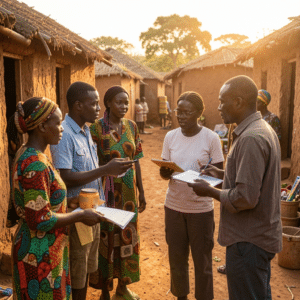
Illustration created by ChatGPT, 26 March 2025
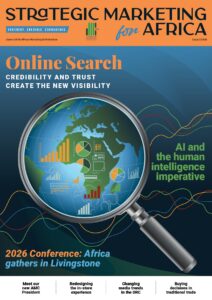
This quote is a powerful reminder of the scale and speed of the shift we’re living through, writes public relations consultant Candice Burgess-Look in the latest issue (Issue 2 2025) of Strategic Marketing for Africa, the magazine of the African Marketing Confederation.
“AI isn’t a fad or gimmick we’ll lose interest in … the horse has bolted and there’s no going back,” notes Burgess-Look, Director of KOJ PR and Communication.
For example, McKinsey & Company’s latest ‘State of AI’ report, cites that 78% of companies globally are using artificial intelligence in their business operations, with 92% planning to increase investment over the next three years.
To put this further into context, there are 333-million companies worldwide, and 300-million of these organisations are already using or actively exploring AI.
So why is adoption slower in the public relations sector? The 2025 ‘Glass House PR Report’, which surveyed firms in at least 15 African countries, found that, while 46% of PR agencies have started integrating AI tools into their processes, widespread adoption across the industry remains in its infancy.
Hesitancy and discomfort in the industry
Burgess-Look believes hesitancy and discomfort amongst African public relations professionals about artificial intelligence is prevalent for several reasons.
“As communicators, we pride ourselves on crafting authentic messaging and working with integrity – qualities some see as threatened by AI. This is where I believe a large knowledge gap exists,” she says.
“If you learn to work with AI in a way that supports your creative process, rather than replaces it, you’re less likely to fear losing your craft, your voice, or your sense of ownership over your work. And you’ll be far better positioned to outperform those who resist the shift.”
Looking at those already experimenting with AI, the benefits are undeniably tangible, Burgess-Look believes.
As an example, Bravado – the digital experience agency of South African integrated advertising agency group, Brave Group – deployed AI to power financial services group Nedbank’s award-winning ‘We’re for Africa’ campaign at the end of 2024.
According to Nomthandazo Mbatha, Marketing and Communications Manager for Africa Regions at Nedbank, the bank achieved an 81% reduction in costs and generated over 6.7-million impressions across social platforms.
“The AI took in a campaign brief and, in one integrated environment, produced a full marketing, internal and external comms strategy alongside creative content, social media posts and production assets. All this was built in just 12 days,” Burgess-Look says.
You can read more on her analysis on how the African public relations industry can balance AI’s promise with responsibility in the new issue (Issue 2 2025) of Strategic Marketing for Africa. Find the Digital Edition here. A print edition will be available shortly.

SA’s Advertising Regulatory Board finds Kia advertisement could be offensive to people with certain health disorders.

Global study finds AI is helping marketers produce more – but is not creating the time and creative space they expected.

Urban Africa will double its footprint, adding the equivalent of more than 4,000 Manhattans or almost 400 Singapores, The Economist reports.

Luc Demez brings experience from Europe and African countries as the Carrefour brand looks to expand into Nigeria with a local partner.

What makes brands successful in Africa? A summary of the award-winning paper presented at Esomar’s first conference in Africa.

Woolworths supermarket chain embraces an AI-powered chef as it leverages two decades of recipes to answer an age-old family question.

Consumers are prioritising their wellness despite tighter wallets, meaning sportswear remains one of the most resilient areas of fashion.

Nominations for the 2026 African Marketing Confederation and African Supply Chain Confederation awards close on 31 July.

Consumers may stick with troubled brands because their emotional attachment overrides the perceived risk, study finds.

Book draws a line between customer experience – the private-sector marketing discipline – and what its authors call ‘Citizen Experience’.

Six years ago, the historic South African department store chain was in voluntary business rescue. Now it plans to open 50 new stores.