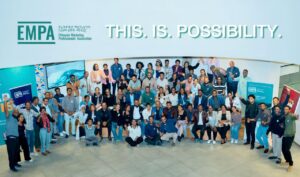
Pre-conference masterclass discusses taking African brands to the world
Participants challenged to identify, articulate and commercialise the cultural assets that make their brand ready for a global audience.
MARKETING ACHIEVEMENTS
By our African Marketing Confederation News Team | 2025
Dr Sharp received the European Marketing Confederation’s Lifetime Achievement Award as part of the first International Day of Marketing.
The European Marketing Confederation (EMC), a partner of the African Marketing Confederation (AMC), has honoured Australian marketing guru, Dr Byron Sharp, with its prestigious Lifetime Achievement Award for Marketing.
Dr Sharp is best known for his groundbreaking book ‘How Brands Grow’, which has fundamentally changed how marketers think about brand growth. His work has inspired professionals across the globe to embrace evidence over intuition – shifting the marketing discipline toward data, reach, distinctiveness and scientific rigor.
Dr Byron Sharp. Photo: LinkedIn
As Director of the Ehrenberg-Bass Institute, a global research institute focused on marketing science, Dr Sharp has published over 100 peer-reviewed articles and continues to be one of the most cited voices in marketing science.
“His influence on the marketing industry cannot be overstated,” said Dr Ralf Strauss, Chairman of the EMC. “His boldness in challenging industry orthodoxy and his dedication to advancing the discipline make him a deserving recipient of this award.”
International Day of Marketing
The award was made by the EMC on 27 May, as part of the first International Day of Marketing. The date was chosen to coincide with the birthday of marketing guru Philip Kotler, born on that day in 1931. The day aims to highlight the importance of marketing in business and society, promote pride in the profession, and celebrate marketing in a bright way.
On his LinkedIn profile, Dr Sharp describes himself as “an old-fashioned scientist (known for research that seeks to discover and describe law-like patterns). But I study a ‘new’ area – marketing (buying behaviour and brand competition)”.
The Ehrenberg-Bass Institute, based at the University of South Australia, is staffed by 50-plus academic personnel. Their pioneering work is supported by corporations around the globe such as General Motors, Henkel, Lindt, PepsiCo, Mondelez, Mars and Novartis.
Late last year, the European Marketing Confederation and the African Marketing Confederation announced that they have joined forces to enhance the global marketing landscape through a strategic partnership focused on sharing best practices, advancing skills, and promoting education in marketing, sales and service.

Participants challenged to identify, articulate and commercialise the cultural assets that make their brand ready for a global audience.

Second outlet planned for Nairobi before year end, with Nigeria, South Africa and Morocco said to be future target markets.

Online search behaviour has changed significantly with the rise of AI. How can African brands adapt to this new marketing landscape?

Researchers propose a framework for packaging that senses, learns and acts – making packaging an active, AI-powered tool against food waste.

Country needs marketers to build recognition and consumer trust around Malawian products and national brand, says Deputy Minister.

Fashion brand suspends giant lingerie high above the city’s streets, using shadows to create a moving billboard for pedestrians and motorists.

Researchers describe AI influencers as having a ‘dual identity’. Consumers evaluate both ‘person’ and ‘technology’ identities at once.

Reputation and trust, once modest influences on hotel choice, have become some of the strongest predictors of patronage, study finds.

South African brands are increasingly setting the global benchmark for customer loyalty strategies, organisers say.

Global influences among younger consumers are still present, but they are being filtered through a distinctly Zambian lens.

Researchers find that lack of perceived ‘genuine care’ is the mechanism connecting AI involvement to lower trust ratings.