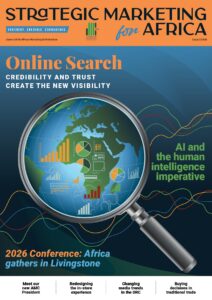
Search is fragmenting – credibility and trust create the new visibility
Online search behaviour has changed significantly with the rise of AI. How can African brands adapt to this new marketing landscape?
BRANDING
By our African Marketing Confederation News Team | 2026
A small on-screen moment, but a significant cultural nod to one of the country’s most recognisable agricultural exports, industry body says.
Down Cemetery Road, the much-anticipated Apple TV+ thriller starring screen legends Emma Thompson and Ruth Wilson, has put a spotlight on South Africa’s, world-celebrated herbal drink, Rooibos.
Photo: André Helbig, Wikimedia Commons
Streaming globally on Apple TV+, the British drama is set in suburban Oxford in England, where an explosion and the unexplained disappearance of a child disrupts an otherwise quiet community. The story follows art restorer, Sarah Trafford (Wilson), who turns to private investigator Zoë Boehm (Thompson) to uncover the truth.
In Season 1, Episode 3, titled “Filthy Work”, Zoë casually suggests sharing a cup of “rooi-bosch tea”, giving the investigation a brief, humanising pause amid the rising tension.
Adele du Toit, spokesperson for the SA Rooibos Council (SARC) says every time Rooibos appears in international fiction or on screen, it’s a small, but meaningful victory for the nation’s cultural footprint.
“It’s not just a drink, but a symbol of South Africa’s unique biodiversity and the growing global embrace of our homegrown flavours,” she says.
Rooibos appears in literature and film
Du Toit adds that Rooibos has developed an interesting association in literature and film, particularly in detective fiction, where it often accompanies moments of reflection, analysis and problem-solving.
From the much-loved The No. 1 Ladies’ Detective Agency series by Alexander McCall Smith to South African-based crime novels by Deon Meyer, Rooibos frequently appears alongside investigators piecing together complex puzzles.
“It’s fascinating how often Rooibos is present when fictional detectives are connecting the dots,” Du Toit observes.
“While writers may choose it for its cultural authenticity or warmth, science suggests it may offer more than comfort. Its naturally caffeine-free profile and antioxidant content are associated with reduced stress and mental clarity – qualities any investigator, fictional or real, would value.”
Rooibos (Aspalathus linearis) grows exclusively in the rugged fynbos region of the Cederberg in the Western Cape province and has become widely consumed for its mild flavour and versatility.

Online search behaviour has changed significantly with the rise of AI. How can African brands adapt to this new marketing landscape?

Researchers propose a framework for packaging that senses, learns and acts – making packaging an active, AI-powered tool against food waste.

Country needs marketers to build recognition and consumer trust around Malawian products and national brand, says Deputy Minister.

Fashion brand suspends giant lingerie high above the city’s streets, using shadows to create a moving billboard for pedestrians and motorists.

Researchers describe AI influencers as having a ‘dual identity’. Consumers evaluate both ‘person’ and ‘technology’ identities at once.

Reputation and trust, once modest influences on hotel choice, have become some of the strongest predictors of patronage, study finds.

South African brands are increasingly setting the global benchmark for customer loyalty strategies, organisers say.

Global influences among younger consumers are still present, but they are being filtered through a distinctly Zambian lens.

Researchers find that lack of perceived ‘genuine care’ is the mechanism connecting AI involvement to lower trust ratings.

Explore the 2026 AMC Conference speaker line-up. Top African marketing voices gather in Zambia to tackle AI, AfCFTA, and brand power. Register today.

New industry currency will bring South African television and online video audiences together in a single measurement system.