Ethiopia moves to bolster its coffee exports to the Chinese market
Opening of an Ethiopian coffee-trading centre in Zhuzhou will establish direct sales channels, boost relationships and host product displays.
ONLINE SHOPPING
By our African Marketing Confederation News Team | 2025
Researchers examine how emphasising CSR credentials can overcome consumers’ hesitancy to shop across borders.
Online shopping is revolutionising how we access and purchase products from international markets. Despite this growth, many consumers remain hesitant to purchase goods from foreign businesses due to trust issues, cultural differences, and concerns about unfamiliar products.
Photo by Sora Shimazaki from Pexels
A new study led by Assistant Professor Ha Kyung Lee from Chungnam National University in South Korea investigates how global companies can overcome these challenges by simplifying online shopping and highlighting their corporate social responsibility (CSR) efforts.
The paper, titled ‘How do online sales channels affect global product purchases? The role of CSR and cross-country differences’, was published in the Journal of Retailing and Consumer Services in November 2024.
The researchers analysed the behaviour of online shoppers from South Korea and Japan. They found that companies’ social contributions – such as supporting environmental or social initiatives – strengthen the positive effect of online ‘purchasability’ on purchasing frequency.
“When consumers find it simple to shop online, they are more likely to purchase global products. In fact, CSR initiatives significantly strengthen this link between online purchasability and purchase frequency,” Professor Lee explains.
One of the most surprising findings was the difference in consumer responses between South Korea and Japan. Japanese consumers, who are generally less active in online shopping than South Koreans, showed a stronger response to CSR.
Influence of social contributions on purchasing behaviour
“[For] Japanese consumers, CSR cues likely helped reconcile their positive perceptions of online shopping with their hesitancy to engage, making the influence of social contributions on purchasing behaviour stronger in Japan than in South Korea,” says Lee.
This suggests that CSR can help build trust and overcome consumer hesitation to buy from foreign businesses, but that the effect of this might also be influenced by cultural predispositions.
Businesses can apply these findings by improving usability and transparency while incorporating CSR messaging into their platform, the researchers believe.
This approach is particularly important in markets where trust in foreign brands is still developing. For companies entering new markets, CSR can act as a strategic tool to boost consumer confidence and overcome cultural or digital barriers.
Looking ahead, the study’s findings are likely to have long-term implications. CSR could act as a powerful tool when tailoring strategies to countries with lower online shopping adoption.
“Over time, CSR could become a standard feature in global e-commerce, helping bridge the digital divide and making online shopping accessible to more people,” Lee concludes.
You can find out more about the study here.

Opening of an Ethiopian coffee-trading centre in Zhuzhou will establish direct sales channels, boost relationships and host product displays.

Rwanda’s evolving modern retail sector is reshaping itself on data-driven consumer insights and local know-how.

From movie-style extravaganzas to conversations with digital clones and enhancing visuals, marketers are doing more than just tinker with AI.

Most recent Black Friday period demonstrated how increasing consumer familiarity with online shopping is driving ongoing demand.

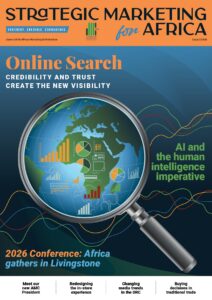
The latest issue of Strategic Marketing for Africa, the magazine for deep-thinking African marketing professionals, is now available.

Brand revamp responds to evolving trends, particularly among younger consumers, while acknowledging Schweppes’ 240-year history.

Partnership ensures Liverpool won’t walk alone as it sees a strong retail opportunity among its growing fan base in Africa.

Latest move in Carrefour’s Africa expansion strategy should see it operating 30 stores in the country with a local partner by 2028.

Certain restrictions on TV and online advertising aimed at kids. Health sector sees it as a first step towards a total ban.

The brands that thrive will treat creativity as a core strategy which underpins sustainable growth, social impact and global engagement

The latest issue of Strategic Marketing for Africa, the magazine for deep-thinking African marketing professionals, is now available.
Dr. Kin Kariisa is an extraordinary force at the helm of Next Media Services, a conglomerate encompassing NBS TV, Nile Post, Sanyuka TV, Next Radio, Salam TV, Next Communication, Next Productions, and an array of other influential enterprises. His dynamic role as Chief Executive Officer exemplifies his unwavering commitment to shaping media, business, and community landscapes.
With an esteemed academic journey, Dr. Kariisa’s accolades include an Honorary PhD in exemplary community service from the United Graduate College inTexas, an MBA from United States International University in Nairobi, Kenya, a Master’s degree in Computer Engineering from Huazong University in China, and a Bachelor’s degree in Statistics from Makerere University.
Dr. Kariisa pursued PhD research in Computer Security and Identity Management at Security of Systems Group, Radboud University in Nijmegen, Netherlands. As a dynamic educator, he has shared his expertise as a lecturer of e-Government and Information Security at both Makerere University and Radboud University.
Dr Kin did his PhD research in Computer Security and Identity Management at Security of Systems Group, Radbond University in Nigmegen, Netherlands. He previously served as a lecturer of e-Government and Information Security at Makerere University in Kampala, Uganda and Radbond University in Netherlands.
Dr Kin did his postgraduate courses in Strategic Business Management, Strategic Leadership Communication and Strategies for Leading Successful Change Initiatives at Harvard University, Boston USA.