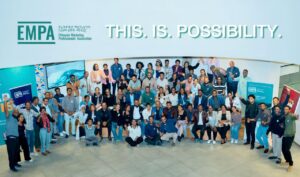
Landmark gathering gets underway with delegates from over 30 countries
Opening plenary hears that securing Africa’s economic future requires businesses to discover new customers and cross-border opportunities.
ECONOMY
By our African Marketing Confederation News Team | 2024
Upcoming report by the African Development Bank Group predicts the North African nation’s economy will strengthen by 4% this year.
The economy of the North African nation of Algeria is continuing to strengthen and its gross domestic product (GDP) is predicted to grow 4% in 2024 and 3.7% in 2025, according to the African Development Bank.
Early morning in Algiers. Photo: Muhammed Amine Benloulou, Wikimedia Commons
This is off the back of 3.6% growth in 2022 and 4.2% in 2023 for the country of approximately 50-million people, bordering the Mediterranean Sea between Morocco and Tunisia.
Algeria’s predicted economic growth figures are contained in the African Development Bank Group’s Algeria Country Report 2024, which was previewed by the AfDB last week and will be officially presented in Algiers, the nation’s capital, in mid-September.
According to the report, Algeria’s economic growth is supported by the oil and gas, industrial, construction and services sectors.
Employment patterns show a move towards the services sector to the detriment of agriculture and manufacturing industry, the AfDB states, nonetheless noting that the structure of GDP has not fundamentally changed, and that the country should implement further reforms to speed up the structural transformation of its economy.
Additional financial resources for Algeria’s structural transformation
“In the short term, additional financial resources for Algeria’s structural transformation could come from an improvement in mobilising domestic funding and strengthening the sustainability of the public finances,” stresses the AfDB document.
The report claims to be an essential tool for political decision makers, investors and development partners and will be presented to Algerian government leaders, the private sector and the media at the bank’s local headquarters in Algiers during September.
Meanwhile, an analysis by the Economist Intelligence Unit says gas exports to Europe from Algeria will continue to grow due to Russia’s invasion of Ukraine and Europe’s need to find alternative sources of energy.
“Although rising gas exports and additional foreign investment in the country will boost Algeria’s overall economic activity in 2024, prospects will remain constrained by an over-centralised management and an opaque business environment dominated by a small number of vested interests,” the unit states.
For African nations seeking export opportunities to Algeria, these appear limited. The country imports mainly capital goods (goods that are used in producing other products) foodstuffs and consumer goods. These are typically sourced from France (Algeria is a former overseas department of France), China, Italy, Spain and Germany.
Statista’s Ease of Doing Business Index – last done for Algeria in 2020 – rated the country below the average in the Middle East and North Africa region.

Opening plenary hears that securing Africa’s economic future requires businesses to discover new customers and cross-border opportunities.

Participants challenged to identify, articulate and commercialise the cultural assets that make their brand ready for a global audience.

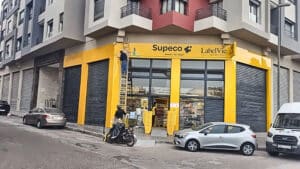
Second outlet planned for Nairobi before year end, with Nigeria, South Africa and Morocco said to be future target markets.

Online search behaviour has changed significantly with the rise of AI. How can African brands adapt to this new marketing landscape?

Researchers propose a framework for packaging that senses, learns and acts – making packaging an active, AI-powered tool against food waste.

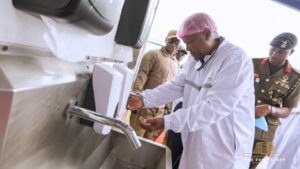
Country needs marketers to build recognition and consumer trust around Malawian products and national brand, says Deputy Minister.

Fashion brand suspends giant lingerie high above the city’s streets, using shadows to create a moving billboard for pedestrians and motorists.

Researchers describe AI influencers as having a ‘dual identity’. Consumers evaluate both ‘person’ and ‘technology’ identities at once.

Reputation and trust, once modest influences on hotel choice, have become some of the strongest predictors of patronage, study finds.

South African brands are increasingly setting the global benchmark for customer loyalty strategies, organisers say.

Global influences among younger consumers are still present, but they are being filtered through a distinctly Zambian lens.