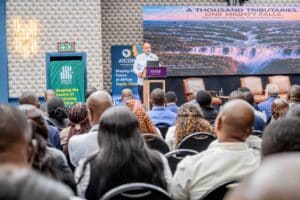
Africa’s economic reset requires moving from ambition to execution
The Africa Commerce Convergence Summit keynote address identified four elements that must converge if the continent is to achieve a meaningful economic reset.
CONSUMER TRENDS
By our African Marketing Confederation News Team | 2025
Increasingly, people want to find more balance and are seeking self-knowledge, discovery and new lifestyle choices, annual VML study finds.
VML, which claims to be the world’s biggest creative company, has released the 11th edition of its The Future 100 report which analyses trends across 14 countries and predicts how these will impact business and culture in the years ahead.
Photo: VML
The research team has found conflicting desires of digital innovation versus analogue pursuits, fear for the future versus hope for society, and simpler living versus out-of-this-world experiences.
What’s Stressing Us Out
Globally, people cite the cost of living, violence and crime, and war and unrest as the top three concerns facing society today, pointing to stress as a major challenge to human wellbeing.
Unsurprisingly, violence, crime and the cost of living feature prominently for South Africans too. SA is one of the 14 markets surveyed by VML for the latest report.
Unemployment is the biggest concern among South Africans, with 74% of local respondents naming this factor among the five most pressing issues facing society. Unemployment also topped the list of responsibilities that South African respondents believe companies hold, followed by cost of living and poverty.
Prioritising Wellbeing
The desire expressed in last year’s report for deceleration has evolved into a more proactive quest for self-knowledge, discovery and new lifestyle choices, the researchers say.
Globally, consumers are prioritising spending on health and wellbeing to find some balance. A third of South African respondents are spending more on their health and wellbeing, while only 15% report cutting back in this area.
“In a world that seems out of control, looking after oneself can feel tangible and manageable,” the researchers comment.
South African respondents long for a simpler existence. An amazing 95% agreed (70% strongly) that they wish life could be simpler sometimes. This is well above the 87% of global respondents, of which only 44% agreed strongly.
Generationally, Millennial respondents are the generation most craving simplicity (73%), followed by Gen Z at 69%. Gen X and Boomer respondents were not far behind though, at 65% and 61% respectively.
“As South Africans, we face many of the same challenges as the global community, yet we’re also deeply impacted by unique local issues – chief among them unemployment and poverty,” observes Parusha Partab, Chief Strategy Officer at VML South Africa.
“In fact, unemployment and poverty are even bigger concerns for South Africans than for many around the world, and these issues are something we face every day in a very real way. Brands that can alleviate these burdens – by offering accessible solutions or simplifying daily life – can foster stronger loyalty and improve brand equity.”
Meanwhile, nearly 70% of respondents globally, and two-thirds of South African respondents, indicated that they are “actively looking to buy or own less stuff”. This is a particularly resonant sentiment following the frenzy of the country’s annual December summer holidays, presenting brands with a challenge to adapt to the budget-conscious, yet purposeful, consumer.
When it comes to alcohol, 49% of South African respondents indicated they are cutting back on spending – either ‘somewhat’ or ‘greatly’.
“The Future 100 ushers in a year of possibilities, where new realities are in the making, human potential is being redefined, lifespans are extended and a new creative economy is emerging thanks to technological advances,” comment Emma Chiu and Marie Staford, the Global Intelligence Directors at VML who authored the report.
You can read the full report here.

The Africa Commerce Convergence Summit keynote address identified four elements that must converge if the continent is to achieve a meaningful economic reset.

Vongani Mageza brings more than 20 years’ experience across financial services and FMCG) companies such as FNB and Diageo.

AI agents will influence shopping, algorithms will supersede social connections, and the clip economy will change how brands connect.

The brand partnership includes a new TV commercial featuring Kipchoge, digital storytelling, wellness initiatives and community programmes.

Modern retail in Africa is still dwarfed by the traditional trade. Marketers who dismiss this relationship-heavy retail model do so at their peril.

Research finds brands don’t just sell products. They can also provide employees with stories through which they feel their work is meaningful

Honesty must be demonstrated through transparency, accountability and action – shaping both reputation and future trust following a crisis.

In the funeral plan category, where most advertisements look like an obituary, Standard Lesotho Bank opted to ‘sell the cow’, not the policy.

Strategic Marketing for Africa, the publication for deep-thinking African marketing professionals, is not to be missed.

CEO of Scopen says the expansion into East Africa is a natural progression following the success of the research in South Africa.

Report says around 80% of Africa’s annual goods export potential to the Caribbean remains untapped.