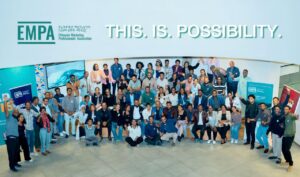
Landmark gathering gets underway with delegates from over 30 countries
Opening plenary hears that securing Africa’s economic future requires businesses to discover new customers and cross-border opportunities.
GREENWASHING
By our News Team | 2023
Environmental groups place spoof ads on around 400 OOH sites in European cities to accuse big auto brands of greenwashing.
Leading automotive brands BMW and Toyota have come under fire in Europe from environmental activists, who hijacked around 400 corporate advertising spaces in 14 cities to accuse the companies of greenwashing.
Three activist groups targeted OOH media sites in railway stations, at bus stops and on city streets to highlight what they claim are misleading adverts and aggressive lobbying tactics used by the auto industry – specifically Toyota and BMW.
One of the billboards targeting Toyota for alleged greenwashing. Photo credit: Brandalism
Their timing coincides with the 100th anniversary of the European Motor Show in Brussels, Belgium. The show runs from14 to 22 January.
The advertising billboards – each with #BanFossilAds – carry headlines such as “Let’s Ruin Everything” (Toyota), “Toyota Land Crusher”, and “When We Test Our Emissions, The Test Dummy – Is You” (BMW).
Using advertising to greenwash their public image
In a video released on Twitter, the Brandalism activist group claimed that the reason Toyota and BMW were singled out was because they were ranked amongst the worst companies in the world for lobbying against climate policies. “[They] are using advertising to greenwash their public image whilst lobbying hard against climate regulations,” Brandalism said.
“Activists are using the action to demand more robust policies from governments to regulate the advertising of environmentally harmful products and prevent misleading green claims from big polluters,” the UK-based marketing industry publication, The Drum, reported.
“The Europe-wide action comes at a time of growing international momentum behind the idea of introducing tobacco-style advertising bans on climate-wrecking products, such as fossil fuels and SUVs.
“In France, for example, car advertisements now require a caveat encouraging consumers to walk, cycle or take public transport wherever possible as part of new regulation due to come into force in March 2022.”
Environmental activists have targeted industries such as banking and aviation in the recent past, also accusing them of greenwashing.

Opening plenary hears that securing Africa’s economic future requires businesses to discover new customers and cross-border opportunities.

Participants challenged to identify, articulate and commercialise the cultural assets that make their brand ready for a global audience.

Second outlet planned for Nairobi before year end, with Nigeria, South Africa and Morocco said to be future target markets.

Online search behaviour has changed significantly with the rise of AI. How can African brands adapt to this new marketing landscape?

Researchers propose a framework for packaging that senses, learns and acts – making packaging an active, AI-powered tool against food waste.

Country needs marketers to build recognition and consumer trust around Malawian products and national brand, says Deputy Minister.

Fashion brand suspends giant lingerie high above the city’s streets, using shadows to create a moving billboard for pedestrians and motorists.

Researchers describe AI influencers as having a ‘dual identity’. Consumers evaluate both ‘person’ and ‘technology’ identities at once.

Reputation and trust, once modest influences on hotel choice, have become some of the strongest predictors of patronage, study finds.

South African brands are increasingly setting the global benchmark for customer loyalty strategies, organisers say.

Global influences among younger consumers are still present, but they are being filtered through a distinctly Zambian lens.