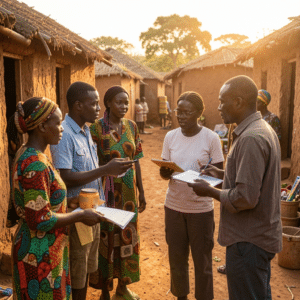
Pre-conference masterclass discusses taking African brands to the world
Participants challenged to identify, articulate and commercialise the cultural assets that make their brand ready for a global audience.
ECONOMIC DEVELOPMENT
By our News Team | 2023
Increasingly, multi-nationals see a need for a direct presence somewhere in sub-Saharan Africa. Kenya may be best placed to take advantage.
Of all the countries in sub-Saharan Africa to be optimistic about, the most promising is Kenya. Economic and political forces are converging to put the continent’s seventh-largest nation in a relatively favourable position to make it the ‘Singapore of Africa’.
This is according to Tyler Cowen, Professor of Economics at George Mason University in the US, author and columnist for financial news agency Bloomberg.
Is Kenya on track to be the ‘Singapore of Africa’? Photo by Waceke Kamau via Wikimedia Commons
He says Africa is the fastest-growing continent and is expected to account for one-quarter of the world’s population by 2050. That means more multinational corporations see a need to have a direct presence somewhere in sub-Saharan Africa.
Many such companies already realise they need a presence in Asia, with Singapore proving increasingly popular as the hub, especially as Hong Kong has been absorbed into communist China.
Where in Africa might such a comparable cluster of companies evolve? Economic growth has slowed in Nigeria, Africa’s most populous nation, and the country has only begun to make much-needed reforms.
Ethiopia, the second-most populous country, just went through a civil war; political problems and power shortages continue to plague South Africa.
“For the time being, those places are not in the running to be a dominant sub-Saharan economic hub, if only because expats will be reluctant to move there,” Professor Cowen notes in a Bloomberg column published last week.
“In contrast, a locale with a reasonable level of English fluency and an attractive year-round climate will get a lot of attention – and that nicely describes Kenya.
Country has consistently good growth rates
“Kenya also had a growth rate of about 5.5% last year, despite negative shocks to the prices of imported food and energy. Since 2004, growth rates have been in the range of 4% to 5%.”
He believes Kenya also has some geographic advantages. It has an extensive coastline on the Indian Ocean, and research suggests that landlocked countries have worse economic performance.
Countries with a coast also find it easier to stay in touch with the rest of the world, and Kenya has relatively easy access to China and India, large markets and sources of capital. In the current geopolitical climate, East Africa is attracting more interest from more sources than is most of West Africa.
“It is also possible that sub-Saharan Africa will not develop a single dominant corporate hub at all,” Cowen notes.
“The United Arab Emirates will continue to evolve into Africa’s financial centre, Lagos will have the most startup activity, South Africa will remain the dominant business centre in the South – and London, Beijing and India will play more important roles in Africa’s economic future.”
He continues: “Still, African distances are great and its population is growing, two simple facts that argue for Kenyan growth no matter what. The idea of putting a manufacturing plant or service centre near Nairobi or Mombasa makes sense even if it serves only East Africa.
“Kenya’s immediate neighbours to the west and south, Tanzania and Uganda, also have an English-language background, and Tanzania may become one of the world’s most populous countries.
“Not only is Africa rising, but East Africa is too. And Kenya is likely to be the easiest and most predictable way to bet on it.”

Participants challenged to identify, articulate and commercialise the cultural assets that make their brand ready for a global audience.

Second outlet planned for Nairobi before year end, with Nigeria, South Africa and Morocco said to be future target markets.

Online search behaviour has changed significantly with the rise of AI. How can African brands adapt to this new marketing landscape?

Researchers propose a framework for packaging that senses, learns and acts – making packaging an active, AI-powered tool against food waste.

Country needs marketers to build recognition and consumer trust around Malawian products and national brand, says Deputy Minister.

Fashion brand suspends giant lingerie high above the city’s streets, using shadows to create a moving billboard for pedestrians and motorists.

Researchers describe AI influencers as having a ‘dual identity’. Consumers evaluate both ‘person’ and ‘technology’ identities at once.

Reputation and trust, once modest influences on hotel choice, have become some of the strongest predictors of patronage, study finds.

South African brands are increasingly setting the global benchmark for customer loyalty strategies, organisers say.

Global influences among younger consumers are still present, but they are being filtered through a distinctly Zambian lens.

Researchers find that lack of perceived ‘genuine care’ is the mechanism connecting AI involvement to lower trust ratings.