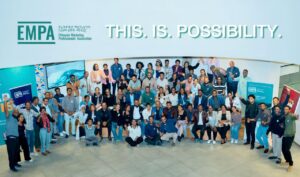
Pre-conference masterclass discusses taking African brands to the world
Participants challenged to identify, articulate and commercialise the cultural assets that make their brand ready for a global audience.
EXECUTIVE APPOINTMENTS
By our African Marketing Confederation News Team | 2024
Khaled Ramadan moves from previous role as Commercial Manager for Nestlé Nigeria and now oversees operations in 16 countries.
Nestlé Kenya Limited has appointed Khaled Ramadan as the new Managing Director and Head for East & Horn of Africa, and Greater Zambezi markets. This is a part of the company’s East and Southern Africa Region (ESAR).
Khaled Ramadan. Photo: Nestlé
With 15 years of experience at Nestlé, he will oversee operations in 16 countries. These include Kenya, Tanzania, Ethiopia, Uganda, Rwanda, Zimbabwe, Mozambique, Malawi and Zambia.
Ramadan joined the company in 2009 as Key Accounts Manager in Kuwait and has since held various leadership roles across the Middle East and Africa.
Established robust governance practices
“His successes include transforming sales organisations, driving digital innovation and establishing robust governance practices in different markets,” Nestlé says in a statement.
“He has also prioritised gender balance and empowered teams to deliver exceptional business performance, including the successful transformation of the sales organisation in Nestlé Iran, and the establishment of Nestlé’s first legal entity in Iraq.”
The statement continues: “In his previous role as Commercial Manager for Nestlé Nigeria, he drove business growth, established solid foundations, and implemented impactful retail women-empowerment programmes while driving breakthrough milestones on route-to-market in rural areas and digital/automation innovations.”
Ramadan holds an MBA from the University of La Sagesse in Lebanon. He has also completed various executive leadership courses at the London Business School.
Nicole Roos, Chairperson and Managing Director for Nestlé, East and Southern African Region, comments: “Khaled brings a wealth of experience and a dynamic vision that aligns with our goals. His leadership style, characterised by inclusivity and strategic thinking, will play a pivotal role in driving the region’s continued growth and achieving high performance.”

Participants challenged to identify, articulate and commercialise the cultural assets that make their brand ready for a global audience.

Second outlet planned for Nairobi before year end, with Nigeria, South Africa and Morocco said to be future target markets.

Online search behaviour has changed significantly with the rise of AI. How can African brands adapt to this new marketing landscape?

Researchers propose a framework for packaging that senses, learns and acts – making packaging an active, AI-powered tool against food waste.

Country needs marketers to build recognition and consumer trust around Malawian products and national brand, says Deputy Minister.

Fashion brand suspends giant lingerie high above the city’s streets, using shadows to create a moving billboard for pedestrians and motorists.

Researchers describe AI influencers as having a ‘dual identity’. Consumers evaluate both ‘person’ and ‘technology’ identities at once.

Reputation and trust, once modest influences on hotel choice, have become some of the strongest predictors of patronage, study finds.

South African brands are increasingly setting the global benchmark for customer loyalty strategies, organisers say.

Global influences among younger consumers are still present, but they are being filtered through a distinctly Zambian lens.

Researchers find that lack of perceived ‘genuine care’ is the mechanism connecting AI involvement to lower trust ratings.