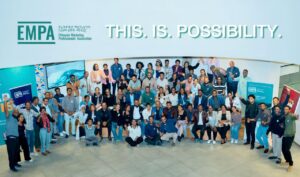
Pre-conference masterclass discusses taking African brands to the world
Participants challenged to identify, articulate and commercialise the cultural assets that make their brand ready for a global audience.
ARTIFICIAL INTELLIGENCE
By our News Team | 2023
Study says around 7.5% of the total agency workforce could have their jobs replaced, but creative problem-solving roles will thrive.
A new report from international research and advisory company Forrester, entitled ‘Agency AI-Powered Workforce Forecast 2030’, reveals that, by 2030, US advertising agencies and related services companies will likely lose 32,000 jobs to automation – 7.5% of the total agency workforce.
While creative problem-solving roles will thrive, process-oriented roles will shrink due to the influence of automation, machine learning and generative AI, the researchers suggest.
Photo by Kampus Production from Pexels
According to Forrester, 56% of CMOs working in the B2C sector in the United States have already used generative AI in marketing, while another 40% are exploring use cases to do so.
Agency jobs most at risk from generative AI include clerical roles (28% of job losses), sales and connected roles (22% of job losses) and market research and connected roles (18% of job losses).
In the US, the agency share of jobs in management, public relations, creative roles, market research, software (including web and digital interface designers), and data science will grow. However, jobs for clerical, sales, finance, administrative and labour-intensive roles will decline.
Some agency jobs are harder to automate
“Job roles like editors and writers – that have a higher generative AI influence – are harder to automate,” the report says.
“These roles are more likely to utilise generative AI technology to automate mundane tasks and increase their productivity. As a result, Forrester predicts a pending inversion of agency workforce composition, from less costly junior talent matched to senior managers, to high-paid creator skillsets paired with generative AI assistants.”
The report finds that originality is the most significant factor that lowers a job’s automation potential. When ‘intelligent creativity’ – a marketing approach that combines creative problem-solving with AI technologies – is deployed, agencies can help make marketing smarter, develop campaigns faster, and make creators more valuable.
Comments the industry news website, Marketing Dive: “The impact of generative AI on agency jobs over the next two years will remain ‘modest’ as ethical and legal issues surrounding the tech, including those related to intellectual property and bias, are hashed out, per Forrester.
“That said, marketers might need to start integrating AI and shoring up their know-how or otherwise fall perilously behind.”

Participants challenged to identify, articulate and commercialise the cultural assets that make their brand ready for a global audience.

Second outlet planned for Nairobi before year end, with Nigeria, South Africa and Morocco said to be future target markets.

Online search behaviour has changed significantly with the rise of AI. How can African brands adapt to this new marketing landscape?

Researchers propose a framework for packaging that senses, learns and acts – making packaging an active, AI-powered tool against food waste.

Country needs marketers to build recognition and consumer trust around Malawian products and national brand, says Deputy Minister.

Fashion brand suspends giant lingerie high above the city’s streets, using shadows to create a moving billboard for pedestrians and motorists.

Researchers describe AI influencers as having a ‘dual identity’. Consumers evaluate both ‘person’ and ‘technology’ identities at once.

Reputation and trust, once modest influences on hotel choice, have become some of the strongest predictors of patronage, study finds.

South African brands are increasingly setting the global benchmark for customer loyalty strategies, organisers say.

Global influences among younger consumers are still present, but they are being filtered through a distinctly Zambian lens.

Researchers find that lack of perceived ‘genuine care’ is the mechanism connecting AI involvement to lower trust ratings.