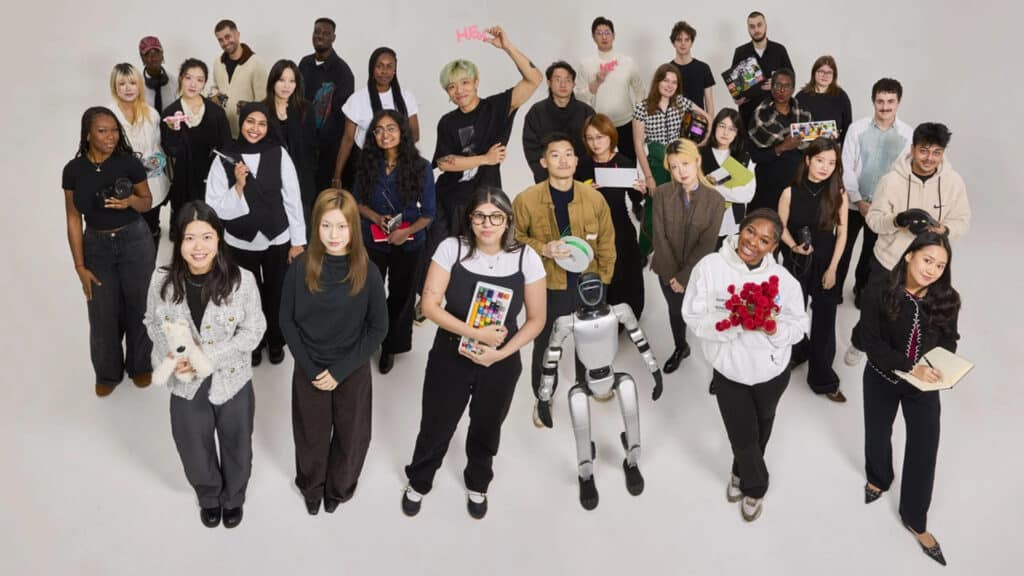
Global advertising holding group WPP has launched a new studio called Hex that it says is designed to help its network address the growing skills gap in artificial intelligence.
Sitting within WPP Production’s content production and innovation teams, it functions simultaneously as a creative production studio, R&D lab and consultancy.
The studio specialises in generative and agentic AI, gaming, immersive experiences and robotics. According to WPP, it is already delivering “innovative work” for its global client roster.
Companies within the WPP stable include VML, Ogilvy, Grey, GroupM and Mindshare. Its client base encompasses the likes of Unilever, Nestlé, The Coca-Cola Company, Amazon and Procter & Gamble.
“Hex’s approach provides a direct solution to one of the economy’s most significant challenges: the AI talent gap,” WPP explains in a statement.
“Recent findings from DataCamp revealed that while 88% of leaders recognise data and AI literacy to be as fundamental as writing, less than half provide basic training. Meanwhile, a 2026 Deloitte report showed that only 25% of companies successfully move AI pilots to production, without the parallel investment in people capabilities.
“The studio is built on the philosophy that cutting-edge AI models alone don’t drive business growth; the real value comes from creative talent that can operationalise the technology.”
Working with technology partners
WPP says the studio works closely with technology partners like Adobe, Google and NVIDIA to test emerging tech and explore real-world applications, embedding teams of forward-deployed experts directly with clients for months at a time to evaluate challenges, build custom solutions and train internal teams to use AI workflows independently.
The human talent for Hex is sourced from WPP’s Creative Tech Apprenticeship, a nine-month paid programme founded by WPP in 2022. With a goal of training at least 1,000 people by 2030, the programme aims to address the industry’s AI skills gap by recruiting from outside traditional ad schools and engineering programmes, with a curriculum focused on creative problem-solving and rapid learning of new technologies.
Richard Glasson, CEO of WPP Production, notes that creative technology sits at the intersection of imagination and craft.
“WPP Production has supported this extraordinary programme from the very beginning because we believe deeply in constantly finding new ways to make the best work,” he comments.