Africa’s economic transformation will depend not on the agreements, institutions and capital already available on the continent, but on our ability to make them work together for the common good.
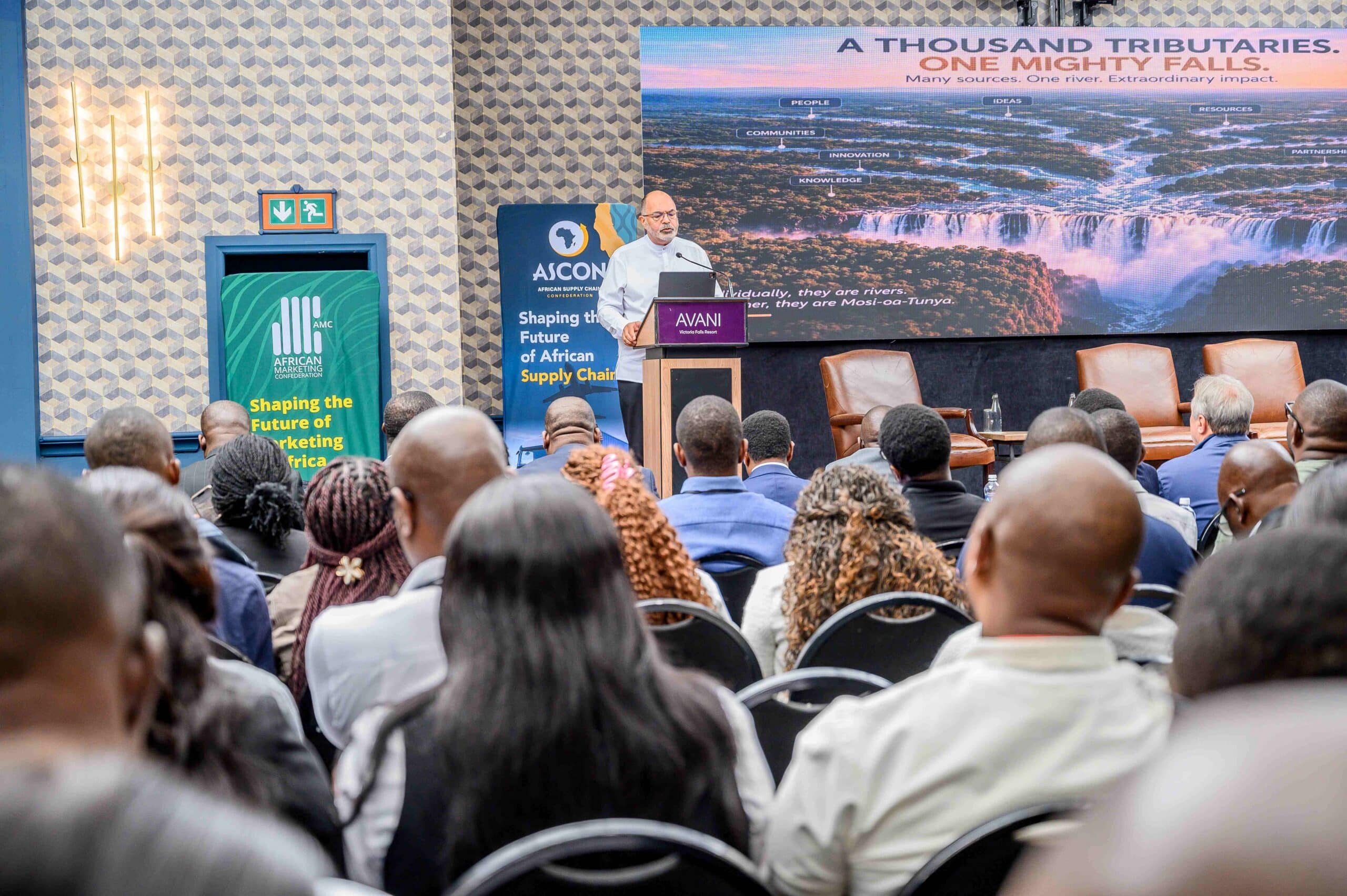
This was the central message from Professor Edward Kieswetter when he delivered the keynote address during the opening plenary of the inaugural Africa Commerce Convergence Summit (ACCS) held in Livingstone, Zambia recently.
The ACCS saw three key professional bodies from across Africa join for the first time to host concurrent conferences. They are the African Marketing Confederation (AMC), Technology Information Confederation Africa (TICON Africa) and African Supply Chain Confederation (ASCON).
Professor Kieswetter is a prominent social activist, academic, business leader and former Commissioner of the South African Revenue Service. His keynote address focused on the theme ‘Africa’s Economic Reset: Mobilising Capital, Revenue and Trade for Industrialisation’.
Drawing on Livingstone’s location on the banks of the Zambezi River at the Victoria Falls, Kieswetter argued that Africa’s economic potential lies in the convergence of many separate ‘tributaries’ – people, institutions, policies, regulations and agreements – to create a collective force capable of delivering meaningful economic and social impact.
“Institutions, when separated, are limited in their impact,” he told delegates from more than 25 countries. “The effort is disconnected and misaligned. Each impact is sub-optimal, so the common good and social impact for ordinary Africans remains sub-optimal. We have never quite built the confluence point of our individual efforts to optimise our beloved continent.”
Four vital elements must converge
He identified four elements that must converge if the continent is to achieve a meaningful economic reset: capital, revenue, trade and industrialisation.
Looking at capital, Africa’s small- and medium-sized enterprises face a financing gap of approximately US$31-billion annually. Yet, Kieswetter argued, the fundamental problem is not the absence of money, but the failure to connect existing capital effectively with enterprises capable of putting it to productive use.
Revenue presents a second challenge. Africa’s average tax-to-GDP ratio is estimated at around 16%, compared with more than 30% across the OECD. At the same time, an estimated $81.6-billion leaves the continent each year through illicit financial flows.
Improving the ability of African countries to capture economic activity within formal taxation systems, he said, could significantly strengthen domestic resources for development.
Discussing the third component of trade, Kieswetter noted that despite the establishment of the African Continental Free Trade Area (AfCFTA), intra-African trade remains low, at an estimated 15-18% of total trade, By comparison, intra-regional trade approaches 60% in Europe and Asia. Africa, he emphasised, still finds it easier to trade with the rest of the world than with itself.
The fourth pillar is industrialisation. Africa accounts for only around 1.5% of global manufacturing, while just 14% of exports leave the continent as value-added goods. Meanwhile, about 80% of what African consume is imported.
The AfCFTA opportunity
Kieswetter said the AfCFTA provides an unprecedented platform for addressing these structural weaknesses. By linking 54 countries and a market of approximately 1.3-billion people, it represents a combined economy worth more than $3.4-trillion. The critical issue, he believes, is not the architecture of the agreement, but its execution.
“This is what I call the ‘execution gap’. Despite the agreement, in Africa we trade more with Rotterdam and Shanghai than what we trade with each other.
“Why? Because logistics costs in Africa run at 25-30% of value-added traded goods, against 8-10% in the OECD because the average customs delay at sub-Saharan African borders is still around 12 days – roughly double that of Latin America.
“And because road transport alone accounts for 29% of the final price of goods traded in Africa, against 7% globally.”
How to close the execution gap
Closing the gap requires more than policy declarations. Kieswetter advocated a disciplined process: identify the real constraint, diagnose it honestly, develop a focused intervention, prove that it works, scale it against measurable objectives and ultimately institutionalise the solution.
The same principle applies to technology, procurement, marketing and professional standards. These systems must operate together if African businesses are to scale across borders.
Ultimately, Kieswetter told conference delegates, efficiency alone is insufficient. Trust is the essential dividend. Even efficient border infrastructure will not guarantee the improved movement of goods if institutions on either side of the border do not trust one another.
“The trust dividend does not appear on a balance sheet, but is the most important asset,” he emphasised.