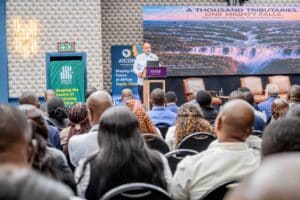
Africa’s economic reset requires moving from ambition to execution
The Africa Commerce Convergence Summit keynote address identified four elements that must converge if the continent is to achieve a meaningful economic reset.
SUPPLY CHAIN
By our African Marketing Confederation News Team | 2025
The 1,700km road linking Egypt with Libya and Chad will help turn ‘the dream of a borderless African market into a reality’.
Egypt’s government has allocated approximately US$124-million for the first phase of a new 1,700 km road that will connect the country with Libya and Chad.
Preliminary survey work is already underway and construction is scheduled to begin in the third quarter of 2025. The project is projected to take three years to complete.
The road is intended to be a new land corridor to increase trade between the three nations, with some experts predicting that it will become a vital artery for commerce in North-Central Africa.
Photo: Wikimedia Commons
Its first phase of around 400 km will run from East El-Oweinat in south-west Egypt to the Al-Kufra border crossing with Libya. In all, 400km of road will be inside Egypt, 390km inside Libya, and 930km inside Chad.
Libya Review says the road is expected to play “a key role in enhancing trade, transport and economic cooperation across North and Central Africa, positioning Egypt as a major transit hub for regional commerce”.
Global Highways, a trade publication serving the international road, bridge and tunnel construction industry, adds that the road will provide all three nations with a new route, boosting trade and economic development in the region.
“The road project will be of particular benefit to landlocked Chad, as it will give the country access to ports in Libya and Egypt,” notes Global Highways.
Egyptian contractors have experience in these challenging conditions
An Egyptian-based construction company, Arab Contractors, is building the first section of road, with the publication commenting that “Egyptian contractors have considerable experience in building roads in these extremely challenging conditions and will be well-placed to win further packages of works for the project”.
Among those who are bullish about the project is economic lecturer Dr Norhan Abdel Rahman. She believes it is more than just asphalt and construction; it’s a strategic corridor designed to catalyse trade, deepen regional integration and unlock a new chapter of prosperity for North and Central Africa.
“By bridging the vast distances between them, Egypt and Chad are not only strengthening their own economic futures but also creating a vital artery for commerce that will resonate across the continent,” Rahman writes in a report published by the non-profit policy research organisation, Africa Narratives.
“By replacing lengthy and expensive sea voyages with a direct land route, the project will cut transit times between Egypt and Chad from months to mere days. This dramatic increase in efficiency will make Egyptian goods more competitive in Central Africa and open up the vast African market for Egyptian companies. For Chad, it provides a crucial gateway for its exports … to reach global markets via Egypt’s Mediterranean ports.”
She adds that trade between the Egypt and Libya is already robust and the new road will solidify and expand this vital economic relationship.
“This initiative is a tangible step towards realising the vision of the African Continental Free Trade Area (AfCFTA), turning the dream of a borderless African market into a reality, one kilometre at a time,” Rahman states.

The Africa Commerce Convergence Summit keynote address identified four elements that must converge if the continent is to achieve a meaningful economic reset.

Vongani Mageza brings more than 20 years’ experience across financial services and FMCG) companies such as FNB and Diageo.

AI agents will influence shopping, algorithms will supersede social connections, and the clip economy will change how brands connect.

The brand partnership includes a new TV commercial featuring Kipchoge, digital storytelling, wellness initiatives and community programmes.

Modern retail in Africa is still dwarfed by the traditional trade. Marketers who dismiss this relationship-heavy retail model do so at their peril.

Research finds brands don’t just sell products. They can also provide employees with stories through which they feel their work is meaningful

Honesty must be demonstrated through transparency, accountability and action – shaping both reputation and future trust following a crisis.

In the funeral plan category, where most advertisements look like an obituary, Standard Lesotho Bank opted to ‘sell the cow’, not the policy.

Strategic Marketing for Africa, the publication for deep-thinking African marketing professionals, is not to be missed.

CEO of Scopen says the expansion into East Africa is a natural progression following the success of the research in South Africa.

Report says around 80% of Africa’s annual goods export potential to the Caribbean remains untapped.