Pre-conference masterclass discusses taking African brands to the world
Participants challenged to identify, articulate and commercialise the cultural assets that make their brand ready for a global audience.
CUSTOMER EXPERIENCE
By our News Team | 2023
Organisations must harness the power of AI to free up their people to do what no robot can do – truly connect with customers.
You would be hard-pressed to find a place today where you are sheltered from the discussion around the endless potential of artificial intelligence and the role it can play in shaping society.
The world over, companies are beginning to feel the pressure to get AI-ready and be seen as innovative and tech-forward. But it’s important to be able to discern the functionality from the hype.
AI cannot empathise with what we, as customers, are experiencing. Photo by Pavel Danilyuk from Pexels
From a customer experience perspective, AI, chatbots and other tech advancements can be incredibly exciting. When it works well, it’s an advantageous enabler. The problem, however, is that it doesn’t always work well, believes Nathalie Schooling, founder and CEO of Nlightencx, an Africa-based customer experience company.
Writing in Issue 3 2023 of ‘Strategic Marketing for Africa’, the magazine of the African Marketing Confederation, she says that when looking at the current customer service options available, it can be narrowed down to four basics: human interaction; self-help; online forum; or chatbots.
Best service came from human interaction
A study conducted by Nlightencx in February this year revealed that 85% of the people found the best service from human interaction, 14% from self-help and FAQs, and only 1% enjoyed interacting with chatbots. These results are not surprising, given that customers are human beings who desire authentic human interaction.
While AI might be efficient and to the point, its biggest downfall is that it lacks an understanding of human emotion. AI cannot empathise with what we, as customers, are experiencing because it has no frame of reference.
At best, it can simulate what it has learned through programming. And, while a bot may be able to use language that mimics compassion, the responses are not authentic and human beings are acutely aware of this.
“There appears to be a resounding consensus that emotional intelligence is one of the main limitations of AI in delivering a great customer experience,” says Schooling.
“It’s for this reason that I believe customers are often left with feelings of frustration after dealing with automated services – because the AI just can’t contextualise understanding, enough to empathise with a customer.”
You can read more about customer experience on page 42 of the latest issue (Issue 3 2023) of Strategic Marketing for Africa, the magazine of the African Marketing Confederation. Read or download the digital edition here.

Participants challenged to identify, articulate and commercialise the cultural assets that make their brand ready for a global audience.

Second outlet planned for Nairobi before year end, with Nigeria, South Africa and Morocco said to be future target markets.

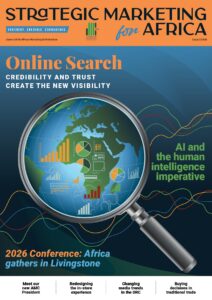
Online search behaviour has changed significantly with the rise of AI. How can African brands adapt to this new marketing landscape?

Researchers propose a framework for packaging that senses, learns and acts – making packaging an active, AI-powered tool against food waste.

Country needs marketers to build recognition and consumer trust around Malawian products and national brand, says Deputy Minister.

Fashion brand suspends giant lingerie high above the city’s streets, using shadows to create a moving billboard for pedestrians and motorists.

Researchers describe AI influencers as having a ‘dual identity’. Consumers evaluate both ‘person’ and ‘technology’ identities at once.

Reputation and trust, once modest influences on hotel choice, have become some of the strongest predictors of patronage, study finds.

South African brands are increasingly setting the global benchmark for customer loyalty strategies, organisers say.

Global influences among younger consumers are still present, but they are being filtered through a distinctly Zambian lens.

Researchers find that lack of perceived ‘genuine care’ is the mechanism connecting AI involvement to lower trust ratings.