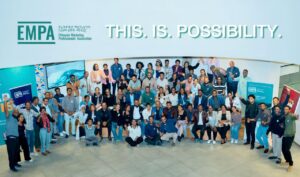
Pre-conference masterclass discusses taking African brands to the world
Participants challenged to identify, articulate and commercialise the cultural assets that make their brand ready for a global audience.
VISUAL + VOICE SEARCH
By our African Marketing Confederation News Team | 2024
The once-simple world of “Google it” is morphing into something far more complex, but potentially rewarding, for Africa’s marketers.
A seismic shift is taking place in online and social search, and the fast-changing landscape will have major implications, and possible benefits, for marketing.
For one, the search-engine old guard (aka Google) is being challenged as younger people prefer to turn to Instagram and TikTok for search and discovery. “Google it” may soon no longer be the generic, all-encompassing verb that it is today.
Digital marketing teams have, for a while now, been aware that Gen Zedders and Generation Alpha consumers have a different view of search than the Google generation.
Another in a long line of studies, this time by US-based marketing technology vendor SOCI, confirmed in March 2024 that Google is in for an intense fight to retain its relevance as a search engine among younger users, with Instagram and TikTok now being the leading (but by no means only) social media platforms of choice when it comes to search.
Photo by Lisa Fotios from Pexels
Observed Damian Rollison, SOCI’s Director of Market Insights: “For businesses, a robust presence on these platforms isn’t just beneficial – it’s critical to winning market share with younger consumers.”
Forbes, the influential business magazine, notes that Google has other challengers too. “Not only is social search on the rise, but generative AI is threatening to disrupt Google’s search cash-cow, which is why Microsoft has partnered with GPT-4 maker OpenAI to inject generative results into Bing,” the publication states in a recent article.
But there are other big changes on the horizon, too.
Rise of visual search
A move towards visual search is one of the hot marketing trends of 2024, according to predictions made by global media-intelligence firm, Meltwater, at the start of the year. Meltwater says this goes hand-in-hand with the growing popularity of shopping on social media platforms.
While word-based search has long dominated the online actions of consumers – and, of course, of SEO digital marketing strategists – new technology now allows users to search for information on the internet using imagery instead of, or in combination with, text keywords.
Consequently, brands are moving quickly to leverage visual-search opportunities to enhance their own digital marketing strategies.
Is Africa going to be part of this trend anytime soon? Mathabo Sekhonyana, Head of Marketing and Communications at Adoozy Power, which claims to be Africa’s first mobile powerbank rental network, believes the answer is ‘yes’.
“The African consumer of the present and of the future is a digital native and is inquisitive to explore new methods and technologies. With this in mind, it is unlikely that visual search will be the exception to this trend,” she tells Strategic Marketing for Africa.
You will find this story, and much more, in Issue 1 2024 of Strategic Marketing for Africa – the voice of African marketing and the official publication of the African Marketing Confederation (AMC).
Read it online or download it here. A print edition of the magazine is also available.

Participants challenged to identify, articulate and commercialise the cultural assets that make their brand ready for a global audience.

Second outlet planned for Nairobi before year end, with Nigeria, South Africa and Morocco said to be future target markets.

Online search behaviour has changed significantly with the rise of AI. How can African brands adapt to this new marketing landscape?

Researchers propose a framework for packaging that senses, learns and acts – making packaging an active, AI-powered tool against food waste.

Country needs marketers to build recognition and consumer trust around Malawian products and national brand, says Deputy Minister.

Fashion brand suspends giant lingerie high above the city’s streets, using shadows to create a moving billboard for pedestrians and motorists.

Researchers describe AI influencers as having a ‘dual identity’. Consumers evaluate both ‘person’ and ‘technology’ identities at once.

Reputation and trust, once modest influences on hotel choice, have become some of the strongest predictors of patronage, study finds.

South African brands are increasingly setting the global benchmark for customer loyalty strategies, organisers say.

Global influences among younger consumers are still present, but they are being filtered through a distinctly Zambian lens.

Researchers find that lack of perceived ‘genuine care’ is the mechanism connecting AI involvement to lower trust ratings.