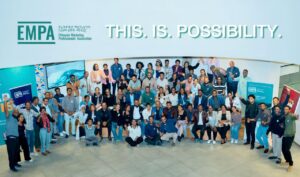
Pre-conference masterclass discusses taking African brands to the world
Participants challenged to identify, articulate and commercialise the cultural assets that make their brand ready for a global audience.
OOH MEDIA
By our News Team | 2023
Industry must raise its focus from maintaining global share at around 5%, to increasing to 10% by 2030, global gathering hears.
The global out-of-home media industry has recovered the ground lost in the pandemic, President Tom Goddard told the World Out of Home Organisation’s Global Congress in Portugal last week.
However, the industry needed to raise its focus from maintaining global market share at around 5%, to increasing to 10% by 2030 through incremental 1% annual increases.
World Out of Home Organisation (WOO) President, Tom Goddard, speaking in Portugal last week. Photo credit: WOO
More than 500 delegates gathered in Lisbon to hear that the keys to driving growth in OOH are:
Goddard, who has headed WOO and its predecessor FEPE International for six years, also announced his intention to step down after a further year, in line with WOO’s board rotation policy.
He was instrumental in the transformation of 60-yearold trade body FEPE into WOO – and its growth to 200 corporate members, including 27 national trade association members. The latter figure stood at zero six years ago.
Why is industry not gaining market share
Discussing global market share for OOH, Goddard noted: “Why is it, with all the investment we’re making in digital screen conversions, in AdTech, and in high-calibre executive hires, we are not gaining share?
“Some of you might rightly point out that other legacy media channels, especially print, have lost huge chunks of share to online, whilst OOH has held its position quite well.
“That’s true. But on my travels around the world, when I look at the impact of our channel everywhere, I can’t help feeling we’re worth much more than 5%”.
Also at the conference, members of WOO’s new Sustainability Task Force appeared on a special panel to outline their plan to create a practical tool kit for OOH companies of all sizes to improve their environmental performance.
Other panels included a review of programmatic and omni-channel selling, and the need to make buying OOH easier across all sides of the industry: media owners, intermediaries and agencies.
The congress was held from 7-9 June in Lisbon, Portugal.

Participants challenged to identify, articulate and commercialise the cultural assets that make their brand ready for a global audience.

Second outlet planned for Nairobi before year end, with Nigeria, South Africa and Morocco said to be future target markets.

Online search behaviour has changed significantly with the rise of AI. How can African brands adapt to this new marketing landscape?

Researchers propose a framework for packaging that senses, learns and acts – making packaging an active, AI-powered tool against food waste.

Country needs marketers to build recognition and consumer trust around Malawian products and national brand, says Deputy Minister.

Fashion brand suspends giant lingerie high above the city’s streets, using shadows to create a moving billboard for pedestrians and motorists.

Researchers describe AI influencers as having a ‘dual identity’. Consumers evaluate both ‘person’ and ‘technology’ identities at once.

Reputation and trust, once modest influences on hotel choice, have become some of the strongest predictors of patronage, study finds.

South African brands are increasingly setting the global benchmark for customer loyalty strategies, organisers say.

Global influences among younger consumers are still present, but they are being filtered through a distinctly Zambian lens.

Researchers find that lack of perceived ‘genuine care’ is the mechanism connecting AI involvement to lower trust ratings.