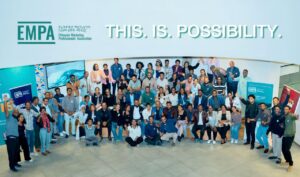
World Marketing Council takes its first steps on the global stage
First Vice President outlines vision to champion professional excellence, ethical practice and innovation in marketing worldwide.
COUNTERFEIT GOODS
By our African Marketing Confederation News Team | 2025
Chinese-based fast-fashion company joins brand names such as Apple and Chanel in Anti-Counterfeiting Coalition.
Chinese e-commerce giant Temu has joined the International Anti-Counterfeiting Coalition’s newly launched council to enhance international collaboration in tackling counterfeit goods.
Representatives of Temu and the IACC sign the MoU. Photo: Temu
The new counterfeit-fighting council, known as the Marketplace Advisory Council (MAC) is a cross-industry forum that encompasses leading online marketplaces, payment providers and global brands. It hopes to set a new standard for co-operation.
Other members of the council include household brand names such as Amazon, Apple, Chanel, Nike, eBay, Mastercard and Disney.
As part of its agreement to join the International Anti-Counterfeiting Coalition (IACC) and Marketplace Advisory Council, Temu has signed a memorandum of understanding to strengthen collaboration on intellectual property protection and expand efforts to combat online counterfeiting.
The memorandum was signed during the IACC’s recent annual conference, which this year took place in San Diego, USA.
“We’re pleased to welcome Temu as an inaugural member of the Marketplace Advisory Council and as a key partner in our shared fight against counterfeiting, said Bob Barchiesi, IACC President.
“The IACC created the MAC to bring stakeholders together in a way that drives real, sustained impact – and Temu’s participation helps strengthen that vision.”
Commented the Chinese-based fast-fashion company in a press statement: “Joining this coalition underscores Temu’s commitment to building a trustworthy online marketplace. We look forward to collaborating with other industry leaders to create a powerful, collective force against the sale of illegal goods online.”
Among Temu’s anti-counterfeiting measures are seller vetting and compliance training, round-the-clock algorithmic monitoring supported by manual review, and a dedicated IP protection portal and brand registry for legal brands to request takedown of illegal goods.
Fakes are a major threat to economies
According to the Organisation for Economic Co-operation and Development (OECD), the global trade in counterfeit goods remains a major threat to economies, consumers and supply chains worldwide.
Based on the latest available data, counterfeit goods accounted for an estimated US$467-billion in global trade in 2021. Since then, the same underlying patterns and risks have continued to drive the global counterfeit trade.
The OECD’s fourth annual report, released in early May 2025, says clothing, footwear and leather goods remained among the most affected sectors, accounting jointly for 62% of seized counterfeit goods.
At the same time, the report noted that counterfeiters are expanding into new sectors reaching nearly every aspect of daily life. Hazardous fakes – including automotive parts, medicines, cosmetics, toys and food – were increasingly prevalent and posed serious risks to consumer health and safety.

First Vice President outlines vision to champion professional excellence, ethical practice and innovation in marketing worldwide.

Zambian organisers of the 2026 gathering officially hand over the baton to an ecstatic Ethiopian delegation. Rwanda to host in 2028.

Opening plenary hears that securing Africa’s economic future requires businesses to discover new customers and cross-border opportunities.

Participants challenged to identify, articulate and commercialise the cultural assets that make their brand ready for a global audience.

Second outlet planned for Nairobi before year end, with Nigeria, South Africa and Morocco said to be future target markets.

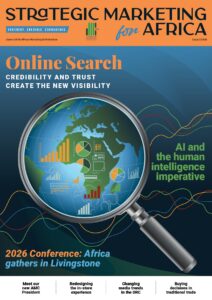
Online search behaviour has changed significantly with the rise of AI. How can African brands adapt to this new marketing landscape?

Researchers propose a framework for packaging that senses, learns and acts – making packaging an active, AI-powered tool against food waste.

Country needs marketers to build recognition and consumer trust around Malawian products and national brand, says Deputy Minister.

Fashion brand suspends giant lingerie high above the city’s streets, using shadows to create a moving billboard for pedestrians and motorists.

Researchers describe AI influencers as having a ‘dual identity’. Consumers evaluate both ‘person’ and ‘technology’ identities at once.

Reputation and trust, once modest influences on hotel choice, have become some of the strongest predictors of patronage, study finds.