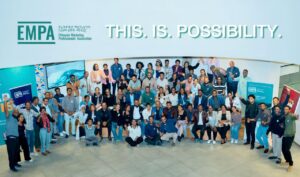
Africa declares a new standard for its communications profession
For too long, the PR landscape has had no shared standard for who practises in it or what responsibility they carry, founders say.
BUSINESS STRATEGY
By our News Team | 2023
Company showed Cover-induced losses in 2019 and 2020, but revised business strategies and customer loyalty has helped turn things around.
Unilever Ghana, the largest producer and retailer of consumer goods in the country, says it is back on a path of sustained growth after recording losses in 2019 and 2020, but returning to profitability in 2021 and 2022.
“As of the first quarter of the [2023] year, the business has posted a profit of GH¢28-million (US$2,55-million), confirming its resolve to keep the growth trajectory in the coming quarters and into the year and beyond,” the publication Graphic Business reports.
Photo courtesy of Unilever
“The company also recorded a turnover of GH¢242-million (US$22-million) in the first quarter while its net cash reserves also recovered from a negative position.”
Unilever Ghana has a stable of popular brands – including Key Soap, Omo, Lux, Geisha, Frytol, Royco, Knorr, Pepsodent, Close-Up, Sunsilk and Annapurna.
Speaking at a recent media event, the Managing Director of Unilever Ghana, George Owusu-Ansah, said the bottom line had been impacted by Covid-19, but revised business strategies and strong customer loyalty had helped to turn the situation around.
“In full recognition of the times we are in, [there] is a continuous focus on our cost and making sure that we are taking out waste and reducing cost so that we don’t burden [consumers] with cost that does not give them any value at all,” he is quoted as saying by the publication Food Business Africa.
Depend on prudent management practices
“As a company, we pledge to continue to depend on our prudent management practices and the full cooperation of staff and distributors to achieve the dream.”
Owusu-Ansah also pledged that Unilever Ghana would continue to work towards a fairer and more socially inclusive world.
The company would help equip 10,000 young people with essential skills by the end of the year, help about 500 small and medium-scale enterprises to grow their business by 2025, and spend US$54,000 annually on diverse businesses by 2025.
From a global perspective, Unilever achieved a strong 2023 first quarter. Results published in April showed a 7% increase in turnover compared to 2022, a 10.5% increase in underlying sales growth, and a 10.7% increase in price growth.
The brands Omo, Hellmann’s, Rexona and Lux produced particularly strong performances.
“Unilever has had a good start to the year, delivering another quarter of strong top line growth. We remain focused on navigating through continued macro-economic uncertainty and are confident in our ability to deliver another year of strong growth, which remains our first priority,” Chief Executive Officer, Alan Jope, said at the time.

For too long, the PR landscape has had no shared standard for who practises in it or what responsibility they carry, founders say.

By carefully selecting followers to engage with an influencer’s post, marketers can significantly increase the post’s spread.

SA’s Advertising Regulatory Board finds Kia advertisement could be offensive to people with certain health disorders.

Global study finds AI is helping marketers produce more – but is not creating the time and creative space they expected.

Urban Africa will double its footprint, adding the equivalent of more than 4,000 Manhattans or almost 400 Singapores, The Economist reports.

Luc Demez brings experience from Europe and African countries as the Carrefour brand looks to expand into Nigeria with a local partner.

What makes brands successful in Africa? A summary of the award-winning paper presented at Esomar’s first conference in Africa.

Woolworths supermarket chain embraces an AI-powered chef as it leverages two decades of recipes to answer an age-old family question.

Consumers are prioritising their wellness despite tighter wallets, meaning sportswear remains one of the most resilient areas of fashion.

Nominations for the 2026 African Marketing Confederation and African Supply Chain Confederation awards close on 31 July.

Consumers may stick with troubled brands because their emotional attachment overrides the perceived risk, study finds.