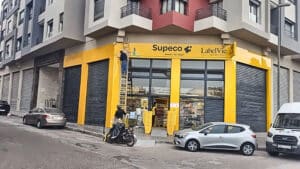
First official Liverpool FC retail stores are opening in Africa
Prominent English Premier League soccer club brings official standalone retail stores to the region for the first time.
H&M, the global fashion retailer, is to move some of its production capacity to Morocco and Egypt as seeks to bring its supply chains closer to target markets.
This is according to reports by international news agencies, as well as media reports emanating from North Africa.
H&M has been losing money in recent years, partly because it has relied on Asian manufacturing hubs in countries such as China and Bangladesh, a model that extended delivery times and reduced its ability to respond quickly to changing consumer demand.
A report by news agency Bloomberg says there has been inventory build-up, which exposed structural weaknesses in H&M’s business model. The company has struggled to keep pace with rapid changes in the global fashion industry, particularly with the acceleration of digitalisation and the rise of more agile competitors like Shein and Zara.
Bloomberg quoted H&M Chief Executive Daniel Ervér as pointing to early signs of improvement, as the company has worked to reduce inventory levels and improve supply chain efficiency. It has succeeded in lowering the inventory-to-sales ratio to its lowest level in a decade, in an effort to restore financial balance.
North Africa’s close proximity to Europe
Moroccan-based news platform Assahifa says H&M believes Morocco, with its close proximity to Europe, is an ideal location, as it will reduce shipping and distribution times, allowing the company to respond more effectively to shifting fashion trends.
“Morocco, for its part, has increasingly positioned itself as a key platform in the textile industry. Several major international brands have established operations in the country, including Inditex, which remains one of the most prominent players in Morocco’s textile sector,” Assahifa reports.
In January, Reuters news agency quoted Adam Karlsson, head of finance at H&M, as saying: “For many reasons we need to create a more regionalised supply chain, both for geopolitical reasons, learning through Covid that we need to create more resilience in our supply chain, and also to support responsiveness and the customer offer.”

Prominent English Premier League soccer club brings official standalone retail stores to the region for the first time.

Latest Chocolate Scorecard reveals uneven progress and gaps in retailer accountability and transparency in cocoa sustainability.

Shoppers are not returning to old habits – they’re redefining them. And affordability is still the single biggest decision driver.

Inefficiencies in South Africa’s state-run rail system have been a major constraint on economic growth over the past decade.

IMM Institute hosts annual Excellence Awards in Johannesburg, honouring top supply chain professionals, teams and emerging talent.

Uganda has unveiled the Packaging Centre of Excellence, a national facility which aims to elevate product branding, packaging standards and market readiness.

IMM Institute hosts annual Excellence Awards in Johannesburg, honouring top marketers, marketing teams and industry up-and-comers.

Good for business, but bad for kids? Researchers concerned about ‘invasive reach and powerful influence of digital marketing techniques’.

Epic watch party-themed campaign for the upcoming FIFA World Cup features major international soccer stars and a touch of Hollywood.

Despite income gains, financial pressure remains visible in consumer behaviour, latest data from the Marketing Research Foundation reveals.

Media Council of Kenya’s latest survey highlights significant change that has implications for regulation, ethics and misinformation.