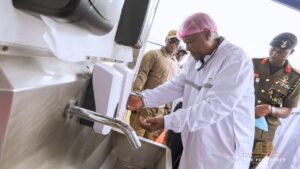
Zimbabwe’s National Foods Holdings Limited has commissioned three new high-technology production facilities in Harare, representing a total investment of almost US$23-million.
The new facilities comprise a breakfast cereals extrusion plant, a biscuit manufacturing line and a pasta facility.
According to local media reports, the investment significantly expands domestic capacity in cereals, pasta and biscuits, while strengthening the country’s push toward import substitution.
“The expansion comes at a time when Zimbabwe continues to rely on imports for a range of processed food products, particularly wheat-based goods such as pasta. The new capacity directly targets these gaps, with the pasta segment emerging as a key focus area,” reports the news outlet Zimbabwe Now.
The new pasta plant is designed to produce approximately 1,200 tonnes of short-cut pasta per month using mostly locally grown wheat. Zimbabwe consumes an estimated 5,000 tonnes of pasta per month, most of which has previously been imported.
Reducing imports at a critical time for the economy
“Driven by increased consumer demand, the pasta line is now operating close to full capacity. This has played an important role in reducing imports at a critical time for the economy,” comments Chief Executive Officer, Mike Lashbrook.
The breakfast‑cereals plant has a monthly capacity of around 800 tonnes, with the unit expected to consume about 15,000 tonnes of locally produced maize each year, thereby supporting smallholder farmers and regional grain markets.
The biscuits line adds further scale to the company’s portfolio of branded snacks and staples, enabling it to meet rising demand in retail channels.
“A key feature of the investment is its linkage to agriculture. The pasta plant alone uses around 1,500 tonnes of locally grown wheat each month, while the company has contracted 4,500 hectares of wheat for the current season, with an expected harvest of 23,000 tonnes,” says Zimbabwe Now.
“As the country’s largest buyer of local wheat, National Foods plays a central role in supporting domestic production, particularly as Zimbabwe seeks to reduce reliance on imported grain.”