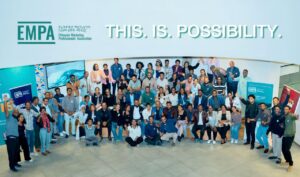
Landmark gathering gets underway with delegates from over 30 countries
Opening plenary hears that securing Africa’s economic future requires businesses to discover new customers and cross-border opportunities.
SPORTS SPONSORSHIP
By our African Marketing Confederation News Team | 2024
Barclays Bank, Official Banking Partner of the tournament, is under fire for claimed links to fossil fuel companies and arms manufacturers.
Organisers of the annual Wimbledon tennis tournament, which is in its second day in London today (Tuesday) are under increasing pressure due to the tournament’s association with sponsor Barclays Bank.
People walk past one of the fake advertisements criticising Barclays Bank and Wimbledon organisers.
Photo: Brandalism
The opening day on Monday attracted headlines for all the wrong reasons when climate activists and pro-Palestinian protestors targeted the event. They are accusing Barclays of ties to fossil fuels businesses and to arms companies supplying Israel.
On Monday, an activist group called Brandalism – which specialises in creating artwork that parodies ‘genuine’ advertising – targeted hundreds of ads on commercial billboards in and around Wimbledon, including at bus shelters and on the underground railway.
One poster shows a tennis player bleeding on a tennis court beside a crater with the words “From Gaza to global warming, we’re making a killing.” Another artwork shows two hands, one of a tennis player and the other of a banker, meeting with the words: “Partners in climate crime and genocide.”
“Wimbledon must stop providing cover for Barclays’ grotesque lack of morals and immediately end the sponsorship deal,” a spokesperson for Brandalism told various UK media outlets.
“Wimbledon’s cherished strawberries and cream image has been thoroughly sullied by its decision to partner with Barclays, the most toxic bank in Europe, while the bank continues to pour millions into the arms trade and fossil fuel companies driving climate chaos.”
Complicity in climate breakdown
Matt Bonner, one of the artists involved in creating about 300 spoof advertisements, added: “Barclays continues to bankroll fossil fuel companies like Shell and BP, which is why we’re showing Wimbledon that this partnership is an endorsement of the bank’s complicity in climate breakdown. There’s no tennis on a dead planet.”
Also on Monday, protesters chanted “Free Palestine” outside Centre Court as people attending the tournament queued to enter the venue. The protest was peaceful.
On Friday, a Barclays spokesperson told the London-based The Guardian newspaper: “We are proud of our partnership with Wimbledon. Like many other banks, we provide financial services to companies supplying defence products to the UK, Nato and its allies. We are also financing an energy sector in transition, including providing US$1-trillion of sustainable and transition finance by 2030 to build a cleaner and more secure energy system.”
Meanwhile, a spokesperson for the tournament organisers, The All England Lawn Tennis & Croquet Club, said: “Our ambition to have a positive impact on the environment is a core part of putting on a successful championships. We know this is one of the defining challenges of our time and we are fully committed to playing our part. Barclays is an important partner of ours and we are working closely with them in a number of areas.”
Barclays became the Official Banking Partner of the event in 2023.

Opening plenary hears that securing Africa’s economic future requires businesses to discover new customers and cross-border opportunities.

Participants challenged to identify, articulate and commercialise the cultural assets that make their brand ready for a global audience.

Second outlet planned for Nairobi before year end, with Nigeria, South Africa and Morocco said to be future target markets.

Online search behaviour has changed significantly with the rise of AI. How can African brands adapt to this new marketing landscape?

Researchers propose a framework for packaging that senses, learns and acts – making packaging an active, AI-powered tool against food waste.

Country needs marketers to build recognition and consumer trust around Malawian products and national brand, says Deputy Minister.

Fashion brand suspends giant lingerie high above the city’s streets, using shadows to create a moving billboard for pedestrians and motorists.

Researchers describe AI influencers as having a ‘dual identity’. Consumers evaluate both ‘person’ and ‘technology’ identities at once.

Reputation and trust, once modest influences on hotel choice, have become some of the strongest predictors of patronage, study finds.

South African brands are increasingly setting the global benchmark for customer loyalty strategies, organisers say.

Global influences among younger consumers are still present, but they are being filtered through a distinctly Zambian lens.