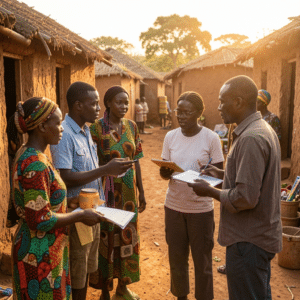
Landmark gathering gets underway with delegates from over 30 countries
Opening plenary hears that securing Africa’s economic future requires businesses to discover new customers and cross-border opportunities.
PRODUCT INNOVATION
By our African Marketing Confederation News Team | 2025
It’s 5,000 years old but mostly unknown outside West Africa. Now, thanks partly to an American brewmaster, fonio’s star is on the rise.
Fonio, an ancient grain celebrated in West Africa for thousands of years but still relatively unknown to most people, is about to get an image boost. This is thanks to the far-sighted efforts of an innovative multi-award winning brewmaster from a boutique brewery in Brooklyn, New York City.
Raphaël Hilarion from Maison Kalao in Dakar, Senegal. Photo: Brooklyn Brewery
Garrett Oliver, a 30-year veteran of Brooklyn Brewery, has been dabbling with fonio grain as a key ingredient in craft beer since 2019. But it’s only recently that he has really thrown his weight behind fonio-based craft beer and, in 2024, has led an international campaign to take fonio beers to consumers around the world.
In doing so, he has enlisted the help of global brands Carlsberg and Guinness, as well as local boutique breweries in Senegal, the UK, Sweden, US and China.
The Senegalese collaborator is Maison Kalao, a pioneering brewery in Dakar. Its founder, Raphaël Hilarion, was busy developing his own recipes for fonio beers when he found out Garrett had beaten him to it.
Each brewery innovates its own product
Each brewery produces its own limited-edition beers to spotlight fonio’s remarkable qualities and potential to drive a more sustainable future. Each brewer contributes his or her own creativity to the lineup of beers. Everything then comes together under the ‘Brewing for Impact’ banner devised by Oliver.
For the uninitiated, fonio is widely used in African cooking and is considered to be the oldest West African cereal. It is used, to a greater or lesser degree, in Guinea, Nigeria, Togo, Benin, Mali, Burkina Faso, Côte d’Ivoire, Niger, and The Gambia.
According to the Science Direct website, it is flexible in that it is grown on the plains as well as in the mountains, and will grow under rainfall conditions that vary from 400mm to 3000mm. Fonio is also capable of thriving in poor, rocky and marginal soils.
Oliver explains: “In some ways ‘Brewing for Impact’ is the most important work I’ve ever done. If what we’ve started truly catches hold in the industry, we will hopefully start seeing the wider use of a grain that has no need for irrigation, fertilisers, pesticides or other chemical inputs.
Find out more about this innovative project (in both English and French) in the current issue (Issue 4 2024) of Strategic Marketing for Africa, the magazine of the African Marketing Confederation.
You can read the Digital Edition online here. The Print Edition will be available shortly.

Opening plenary hears that securing Africa’s economic future requires businesses to discover new customers and cross-border opportunities.

Participants challenged to identify, articulate and commercialise the cultural assets that make their brand ready for a global audience.

Second outlet planned for Nairobi before year end, with Nigeria, South Africa and Morocco said to be future target markets.

Online search behaviour has changed significantly with the rise of AI. How can African brands adapt to this new marketing landscape?

Researchers propose a framework for packaging that senses, learns and acts – making packaging an active, AI-powered tool against food waste.

Country needs marketers to build recognition and consumer trust around Malawian products and national brand, says Deputy Minister.

Fashion brand suspends giant lingerie high above the city’s streets, using shadows to create a moving billboard for pedestrians and motorists.

Researchers describe AI influencers as having a ‘dual identity’. Consumers evaluate both ‘person’ and ‘technology’ identities at once.

Reputation and trust, once modest influences on hotel choice, have become some of the strongest predictors of patronage, study finds.

South African brands are increasingly setting the global benchmark for customer loyalty strategies, organisers say.

Global influences among younger consumers are still present, but they are being filtered through a distinctly Zambian lens.