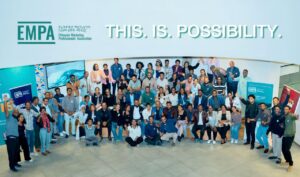
Pre-conference masterclass discusses taking African brands to the world
Participants challenged to identify, articulate and commercialise the cultural assets that make their brand ready for a global audience.
MARKETING OUTLOOK
By our News Team | 2023
While marketers in many countries are worried about a recession, there is also optimism regarding the business climate and marketing budgets.
Warc has released a new report titled ‘The Voice of the Marketer 2024’ that says most marketers (61%) are optimistic and expect business to be better next year than the current year.
With global marketing investment set to increase by 8.2% in 2024 to top US$1-trillion for the first time, as per estimations by Warc Media, the report also illustrates the ongoing investment trend towards digital channels.
Photo by Campaign Creators on Unsplash
However, when exploring measurement techniques for marketing investment, more than a fifth (22%) of marketers employ no form of modelling in their evaluation processes.
“A significant finding from our survey analysis is that while marketers are concerned about the impact of an economic recession, there is also a sense of optimism regarding the business climate and marketing budgets for 2024,” states Isabel Cleaver, Senior Analyst at Warc.
For the second year running, two-thirds (64%) of marketers indicated that economic recession is seen to have the biggest impact on marketing strategies in 2024, with 41% highlighting inflation and the cost-of-living crisis as the biggest challenges they face over the next 12 months.
Sixty percent say budgets will improve
Yet almost two-thirds of marketers (61%) expect that business will improve in 2024 and 41% believe that marketing budgets will increase next year.
In Europe and North America, just over a third expect budgets to be higher in 2024 (37% and 35% respectively). In contrast, half of marketers (50%) in the Asia-Pacific region expect budgets to grow next year.
It appears that more marketers understand that maintaining, or even increasing, investment in brand marketing can be effective in navigating economic downturns.
Comments Grant McKenzie, Chief Marketing Officer for Europe and International at alcoholic beverage business Asahi: “Having been through a couple of these economically challenging times, you have to be very careful not to try to cut costs to the detriment of value … Marketers at these times have to be very careful not to change the strategy where it doesn’t need to change.”
The report is part of Warc Strategy’s programme titled ‘The Evolution of Marketing’, which is designed to help marketers address major industry shifts to drive effective marketing. A third report, ‘The Future of Media’, will be released in January.

Participants challenged to identify, articulate and commercialise the cultural assets that make their brand ready for a global audience.

Second outlet planned for Nairobi before year end, with Nigeria, South Africa and Morocco said to be future target markets.

Online search behaviour has changed significantly with the rise of AI. How can African brands adapt to this new marketing landscape?

Researchers propose a framework for packaging that senses, learns and acts – making packaging an active, AI-powered tool against food waste.

Country needs marketers to build recognition and consumer trust around Malawian products and national brand, says Deputy Minister.

Fashion brand suspends giant lingerie high above the city’s streets, using shadows to create a moving billboard for pedestrians and motorists.

Researchers describe AI influencers as having a ‘dual identity’. Consumers evaluate both ‘person’ and ‘technology’ identities at once.

Reputation and trust, once modest influences on hotel choice, have become some of the strongest predictors of patronage, study finds.

South African brands are increasingly setting the global benchmark for customer loyalty strategies, organisers say.

Global influences among younger consumers are still present, but they are being filtered through a distinctly Zambian lens.

Researchers find that lack of perceived ‘genuine care’ is the mechanism connecting AI involvement to lower trust ratings.