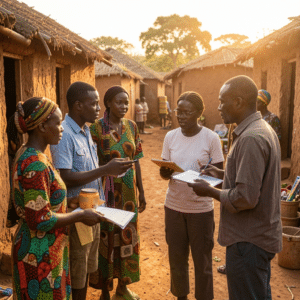
Pre-conference masterclass discusses taking African brands to the world
Participants challenged to identify, articulate and commercialise the cultural assets that make their brand ready for a global audience.
A.M.C. MEMBER NEWS
By our African Marketing Confederation News Team | 2025
African marketer and business leader to present a webinar on Leadership and Creativity for the Ethiopian Marketing Professionals’ Association.
The Ethiopian Marketing Professionals’ Association, a member of the African Marketing Confederation, is hosting an exclusive session on Thursday, 13 February with African marketing and business leader, Yaw Nsarkoh.
Nsarkoh presenting at the 2023 AMC conference. Photo: AMC
The webinar is titled ‘Leadership & Creativity: Lessons from Life for Growth & Impact’ and is open to marketers anywhere, irrespective of whether they are a member of the EMPA.
Nsarkoh spent almost three decades with Unilever, mostly in Africa, and is a former Executive Vice President of Unilever Global Markets. Prior to this, he served as the Managing Director for Unilever Nigeria, and East and Southern Africa.
He has also served on boards in Ghana and across Africa. Key amongst them is as Executive Board Member at Unilever Ghana, and at trade/employee associations and strategic private sector committees. He was previously a Director of the Kenya Association of Manufacturers, Chairman at the East African Shippers Council, and a Director at the Changing Lives Endowment Fund (CLEF).
Speaker at African Marketing Confederation conference
Nsarkoh is a regular speaker on business issues, including marketing and leadership, and was a speaker at the 2023 African Marketing Confederation conference in Uganda, where he gave a presentation on Leadership, titled ‘Growing Resilient People and Adaptive Leaders’.
At the conference, he called for leaders in Africa to empower their brands through big ideas. To create a revolution for the continent’s emerging brands, Africa must nurture its marketers for greatness, Nsarkoh underlined. “Global greatness, not just Ugandan greatness or African greatness. We must produce world-class thinkers in marketing from Africa.”
Comments Fana Abay of the Ethiopian Marketing Professionals’ Association: “The first time I heard Yaw Nsarkoh speak on stage at the African Marketing Confederation conference, I was immediately drawn in – not just by the depth of his content, which traced the roots of branding and brand-building in Africa’s history, but by the power of his African voice and his ethical stance on business.
“For Yaw, business isn’t just about profit – it’s about creating win-win outcomes for everyone involved. That perspective is rare, refreshing and exactly what’s needed to drive sustainable growth in Africa and beyond.”
You can sign up for the webinar here.

Participants challenged to identify, articulate and commercialise the cultural assets that make their brand ready for a global audience.

Second outlet planned for Nairobi before year end, with Nigeria, South Africa and Morocco said to be future target markets.

Online search behaviour has changed significantly with the rise of AI. How can African brands adapt to this new marketing landscape?

Researchers propose a framework for packaging that senses, learns and acts – making packaging an active, AI-powered tool against food waste.

Country needs marketers to build recognition and consumer trust around Malawian products and national brand, says Deputy Minister.

Fashion brand suspends giant lingerie high above the city’s streets, using shadows to create a moving billboard for pedestrians and motorists.

Researchers describe AI influencers as having a ‘dual identity’. Consumers evaluate both ‘person’ and ‘technology’ identities at once.

Reputation and trust, once modest influences on hotel choice, have become some of the strongest predictors of patronage, study finds.

South African brands are increasingly setting the global benchmark for customer loyalty strategies, organisers say.

Global influences among younger consumers are still present, but they are being filtered through a distinctly Zambian lens.

Researchers find that lack of perceived ‘genuine care’ is the mechanism connecting AI involvement to lower trust ratings.