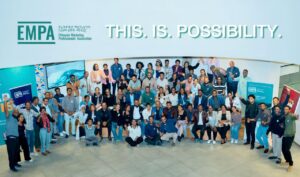
Pre-conference masterclass discusses taking African brands to the world
Participants challenged to identify, articulate and commercialise the cultural assets that make their brand ready for a global audience.
A.M.C. MEMBER NEWS
By our African Marketing Confederation News Team | 2025
Speaking at the inauguration of the CIMG Governing Council, Minister says applying marketing principles can create a ‘fundamental shift’.
Ghana’s Minister for Education and Member of Parliament for Tamale South, Honourable Haruna Iddrisu, has inaugurated the new Governing Council of the Chartered Institute of Marketing, Ghana (CIMG), calling for a fundamental shift in public sector service delivery through strategic marketing principles.
The recent inauguration of the CIMG Governing Council. Photo: CIMG
This inauguration ceremony, held at the Ministry of Education, marked a new chapter for the Institute as it deepens its regulatory role under the CIMG Act, 2020 (Act 1021).
The Minister, in his keynote address, challenged the inaugurated governing council to extend the influence of marketing beyond the private sector to the core of public governance, deepening public sector marketing for accountable governance and effective service delivery.
“Marketing is not just for selling products. At its heart, it is about understanding human needs and delivering value,” Hon. Iddrisu said.
“In the public sector, this means listening, responding and improving how we serve citizens. We need to embed marketing into the way government operates – so that we measure not just infrastructure outputs, but citizen satisfaction.”
To this end, the Minister proposed three bold initiatives: the introduction of a national satisfaction survey across Ministries, Departments, and Agencies (MDAs) to benchmark service delivery; the development of a customer-centric training programme for public servants in partnership with CIMG; and the institutionalisation of Citizen Accountability Forums as a core performance metric for public institutions.
Hon. Iddrisu also praised the immediate past president, Dr Daniel Kasser Tee, for his leadership in repositioning CIMG and achieving key milestones following the enactment of the CIMG Act, 2020 (Act 1021).
Minister’s proposals welcomed
CIMG National President and Council Chair, Mr Michael Abbiw, welcomed the Minister’s proposals, affirming the Institute’s readiness to collaborate with government agencies to build a service culture grounded in trust, responsiveness, and data-driven insights.
“Our Professional Marketing Qualifications and regulatory role place us in a strong position to support this agenda,” Mr Abbiw stated. “We already lead Ghana’s private sector customer satisfaction surveys. Extending this model to the public sector is not only feasible – it is necessary.”
Mr Abbiw outlined the Council’s strategic vision anchored on an eight-point agenda, including expanding the membership base, professional development, and strengthening research and advocacy through its flagship initiatives such as the Ghana Customer Satisfaction Index (GH-CSI) and Ghana Regional Brand Index (GH-RBI).
The Council pledged to deepen engagement with Ministries, Departments, and Agencies (MDAs), educational institutions, and key state actors to elevate marketing’s role in national development and improve the citizen experience across all public services.
This inauguration underscores CIMG’s evolving role as a national thought leader and its commitment to transforming marketing into a catalyst for effective governance and inclusive growth. The newly inaugurated Governing Council is made up of 11 distinguished members who will steer the Institute’s strategic vision over the coming years.
CIMG is a member of the African Marketing Confederation (AMC) and is host of the AMC Conference 2025, which takes place from 20-22 August at the Labadi Beach Hotel in Accra.

Participants challenged to identify, articulate and commercialise the cultural assets that make their brand ready for a global audience.

Second outlet planned for Nairobi before year end, with Nigeria, South Africa and Morocco said to be future target markets.

Online search behaviour has changed significantly with the rise of AI. How can African brands adapt to this new marketing landscape?

Researchers propose a framework for packaging that senses, learns and acts – making packaging an active, AI-powered tool against food waste.

Country needs marketers to build recognition and consumer trust around Malawian products and national brand, says Deputy Minister.

Fashion brand suspends giant lingerie high above the city’s streets, using shadows to create a moving billboard for pedestrians and motorists.

Researchers describe AI influencers as having a ‘dual identity’. Consumers evaluate both ‘person’ and ‘technology’ identities at once.

Reputation and trust, once modest influences on hotel choice, have become some of the strongest predictors of patronage, study finds.

South African brands are increasingly setting the global benchmark for customer loyalty strategies, organisers say.

Global influences among younger consumers are still present, but they are being filtered through a distinctly Zambian lens.

Researchers find that lack of perceived ‘genuine care’ is the mechanism connecting AI involvement to lower trust ratings.