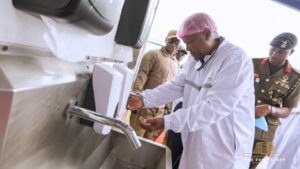
Ethiopia moves to bolster its coffee exports to the Chinese market
Opening of an Ethiopian coffee-trading centre in Zhuzhou will establish direct sales channels, boost relationships and host product displays.
A.M.C CONFERENCE 2025
By our African Marketing Confederation News Team | 2025
Supply chains must evolve as African customers demand faster, smarter and more sustainable solutions, delegates told.
Trust is one of the most important elements of the modern supply chain process, where successful collaboration with other disciplines – such as marketing and ICT – have become vital.
“No trust and no collaboration equals no customer and no transaction. Trust is what makes the synergy real. You can’t do without it,” said supply chain expert Thobekile Nxumalo during her presentation at the 2025 African Marketing Confederation Conference held in Accra, Ghana.
Nxumalo, who is Head of Supply Chain at IQ Business in South Africa, was speaking on the topic ‘Trust, Trends, Technology and Supply Chain: The Unstoppable Combination for Market Success’.
Thobekile Nxumalo discusses supply chain’s evolving collaboration with marketing and technology
Referring to research that she is currently involved in, she said trust has emerged as a strong theme among the research participants.
“Something they all mention is that you can’t make this [collaboration] work without trust. There has to be trust within your value chain and your extended value chain.
“If we think about what happened during Covid, there was panic buying and global disruptions. But one of the key things that made some companies successful is that, beyond the contracts they had, it was the trust and reputation that they had with their retailers, suppliers and customers.
“It emphasises that even your fanciest systems or flashy ad campaigns are insufficient to achieve trust … it goes beyond that.”
Nxumalo said that, as a child growing up in South Africa’s townships, one of the things that led the family to buy from a certain ‘spaza shop’ (informal convenience store) or informal trader was the trust that existed between them.
“We had trust in them that they could deliver on the promises they made. This trust was not built on a once-off event … it was earned; it was built over time.
She emphasised: “Supply chain has a strong role to play in making sure that delivery excellence corresponds with the promise that marketing has made to the customer. What a gorgeous relationship!”
Supply chains must be extremely agile
Nxumalo told delegates that supply chains must also be extremely agile to take advantage of what marketing and technology can bring to the table.
Citing the example of Jumia, the African e-commerce platform, she explained that, at the time Covid hit and lockdowns ensued, Jumia had positioned itself as an online platform selling electronics.
“But what marketing noticed was a shift in consumer needs. Jumia quickly adapted and responded to that need by switching from electronics to providing customer essentials.
“It was not just a supply chain decision; it was marketing and supply chain. Marketing saw the shift in the pattern and supply chain made sure that its model supported the shift.”
Nxumalo noted that, in general, e-commerce in Africa is evolving rapidly due to trends such as growing urbanisation and rising customer expectations around speed of delivery of their online purchases.
“When people place orders online, they want the item yesterday. So, obviously, organisations must ensure they have the relevant supply chain and tech structures in place, and are using marketing insights to respond to important trends. The key insight here is agility. Without it, you simply cannot navigate these trends and drive customer value,” she said.
Pan-African supply chain body
The 2025 AMC Conference was attended by several African supply chain executives, with a view to forming a pan-African supply chain body along similar lines to the African Marketing Confederation. More details about the new organisation will be announced in due course.
You can read more in-depth coverage of Thobekile Nxumalo’s presentation, as well as other 2025 AMC Conference presentations and activities, in the next issue (Issue 3 2025) of Strategic Marketing for Africa, the magazine of the African Marketing Confederation.

Opening of an Ethiopian coffee-trading centre in Zhuzhou will establish direct sales channels, boost relationships and host product displays.

Rwanda’s evolving modern retail sector is reshaping itself on data-driven consumer insights and local know-how.

From movie-style extravaganzas to conversations with digital clones and enhancing visuals, marketers are doing more than just tinker with AI.

Most recent Black Friday period demonstrated how increasing consumer familiarity with online shopping is driving ongoing demand.

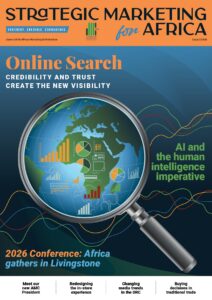
The latest issue of Strategic Marketing for Africa, the magazine for deep-thinking African marketing professionals, is now available.

Brand revamp responds to evolving trends, particularly among younger consumers, while acknowledging Schweppes’ 240-year history.

Partnership ensures Liverpool won’t walk alone as it sees a strong retail opportunity among its growing fan base in Africa.

Latest move in Carrefour’s Africa expansion strategy should see it operating 30 stores in the country with a local partner by 2028.

Certain restrictions on TV and online advertising aimed at kids. Health sector sees it as a first step towards a total ban.

The brands that thrive will treat creativity as a core strategy which underpins sustainable growth, social impact and global engagement

The latest issue of Strategic Marketing for Africa, the magazine for deep-thinking African marketing professionals, is now available.
Dr. Kin Kariisa is an extraordinary force at the helm of Next Media Services, a conglomerate encompassing NBS TV, Nile Post, Sanyuka TV, Next Radio, Salam TV, Next Communication, Next Productions, and an array of other influential enterprises. His dynamic role as Chief Executive Officer exemplifies his unwavering commitment to shaping media, business, and community landscapes.
With an esteemed academic journey, Dr. Kariisa’s accolades include an Honorary PhD in exemplary community service from the United Graduate College inTexas, an MBA from United States International University in Nairobi, Kenya, a Master’s degree in Computer Engineering from Huazong University in China, and a Bachelor’s degree in Statistics from Makerere University.
Dr. Kariisa pursued PhD research in Computer Security and Identity Management at Security of Systems Group, Radboud University in Nijmegen, Netherlands. As a dynamic educator, he has shared his expertise as a lecturer of e-Government and Information Security at both Makerere University and Radboud University.
Dr Kin did his PhD research in Computer Security and Identity Management at Security of Systems Group, Radbond University in Nigmegen, Netherlands. He previously served as a lecturer of e-Government and Information Security at Makerere University in Kampala, Uganda and Radbond University in Netherlands.
Dr Kin did his postgraduate courses in Strategic Business Management, Strategic Leadership Communication and Strategies for Leading Successful Change Initiatives at Harvard University, Boston USA.