
Africa’s economic reset requires moving from ambition to execution
The Africa Commerce Convergence Summit keynote address identified four elements that must converge if the continent is to achieve a meaningful economic reset.
A.M.C. MEMBER NEWS
By our African Marketing Confederation News Team | 2026
Marks a new era of accountability, professional excellence and consumer protection within the local advertising and marketing sector.
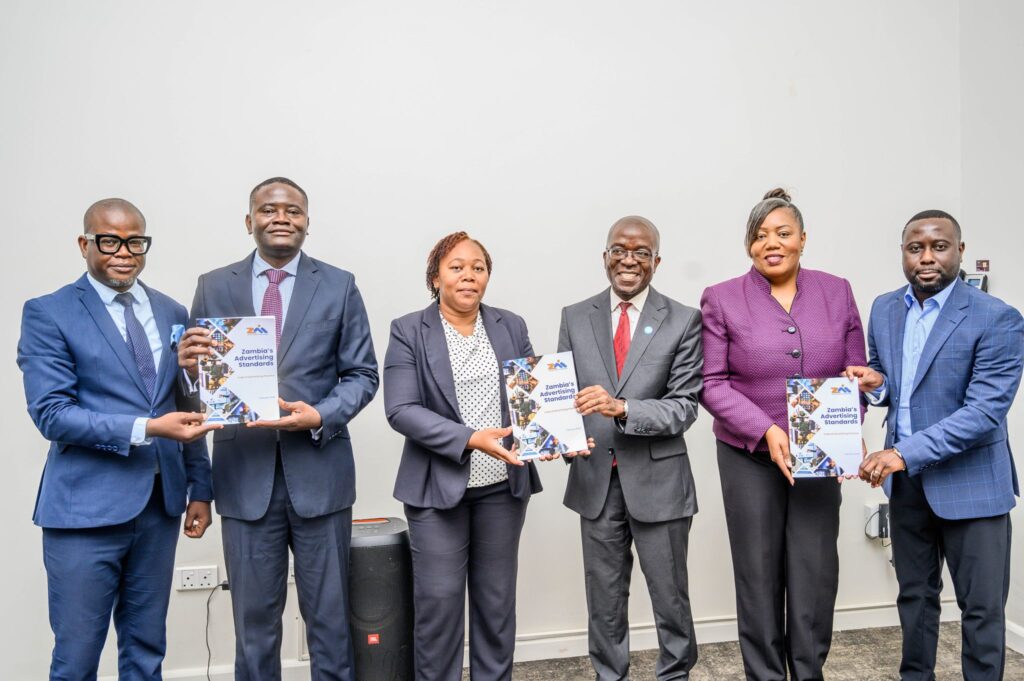
The Zambia Institute of Marketing has launched the Zambia Advertising Standards and welcomed the commencement of the new Advertising Standards Board to oversee them.
Key role–players display the new Advertising Standards. Photo: ZIM
This ushers in a new era of accountability, professional excellence and consumer protection within the Zambian advertising and marketing landscape.
The new standards establish ethical and professional benchmarks for advertising across traditional and digital platforms, with marketing and advertising agencies now required to register and obtain practising licences in line with the country’s laws.
“In today’s highly digital environment, advertising is everywhere – from billboards to social media platforms. The key question is whether these communications meet acceptable standards. Are they appropriate? Do they add value? Do they protect consumers?” said Margaret M. Chikuba, Director of Domestic Trade and Commerce at the Zambian Ministry of Commerce, Trade and Industry.
She was speaking at the official launch, held in Lusaka last week, of the mandatory compliance framework for agencies operating under the Zambia Institute of Marketing (ZIM) Act No. 2 of 2022.
Preserve the integrity of the profession
Addressing attendees at the event, ZIM President Mwewa Besa noted that compliance will help ensure adherence to ethical standards and preserve the integrity of the profession.
He emphasised that the standards are a working document developed through years of consultation. They are not in stone, but will remain dynamic to reflect changes in the industry.
Danny Chanda, CEO of the Zambia Institute of Marketing, said the operationalisation of the Advertising Standards Board is a strategic move to align Zambia’s advertising industry with global best practice.
The initiative strengthens ZIM’s mandate to safeguard high standards of marketing practice and promote honest, responsible and ethical communication.
“This is not merely a ceremonial event. It is a strategic decision to create a more coordinated and efficient system for managing advertising standards in our country,” he said.
The newly appointed Advertising Standards Board is being chaired by the ZIM’s Vice President for Policy, Eric Ngondo.
Zambia Institute of Marketing is a member of the African Marketing Confederation.

The Africa Commerce Convergence Summit keynote address identified four elements that must converge if the continent is to achieve a meaningful economic reset.

Vongani Mageza brings more than 20 years’ experience across financial services and FMCG) companies such as FNB and Diageo.

AI agents will influence shopping, algorithms will supersede social connections, and the clip economy will change how brands connect.

The brand partnership includes a new TV commercial featuring Kipchoge, digital storytelling, wellness initiatives and community programmes.

Modern retail in Africa is still dwarfed by the traditional trade. Marketers who dismiss this relationship-heavy retail model do so at their peril.

Research finds brands don’t just sell products. They can also provide employees with stories through which they feel their work is meaningful

Honesty must be demonstrated through transparency, accountability and action – shaping both reputation and future trust following a crisis.

In the funeral plan category, where most advertisements look like an obituary, Standard Lesotho Bank opted to ‘sell the cow’, not the policy.

Strategic Marketing for Africa, the publication for deep-thinking African marketing professionals, is not to be missed.

CEO of Scopen says the expansion into East Africa is a natural progression following the success of the research in South Africa.

Report says around 80% of Africa’s annual goods export potential to the Caribbean remains untapped.